
Introduction
Suspension clamps and anchor pole hardware are essential components in overhead power and communication line systems. They ensure mechanical stability, safe load transfer, and long-term reliability of conductors installed on poles or towers. This guide provides a comprehensive overview of their functions, structures, types, materials, and applications in modern line infrastructure.
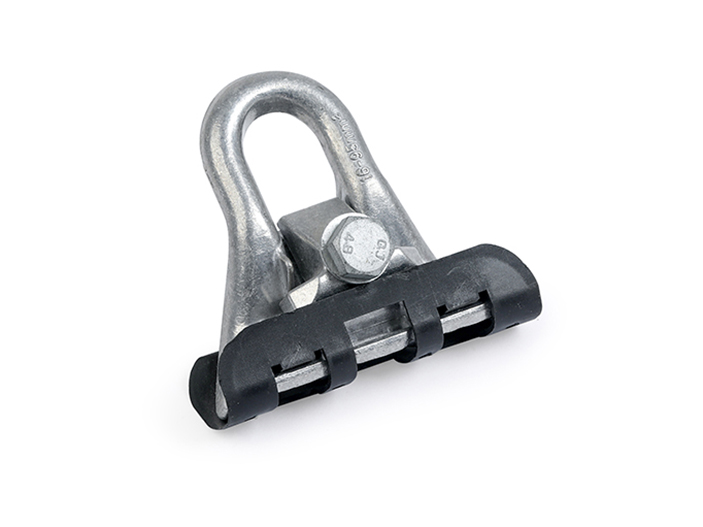
Overview of Suspension Clamps and Anchor Pole Hardware
In overhead line systems, conductors are continuously exposed to mechanical loads caused by their own weight, wind pressure, ice accumulation, and temperature changes. To manage these forces safely, specialized line hardware is required.
Suspension clamps support conductors on straight-line sections of poles or towers while allowing limited movement.
Anchor pole hardware (also called anchoring or dead-end hardware) secures conductors at terminal points, angles, or tension sections where full mechanical load must be transferred.
Together, these components form the backbone of reliable overhead line installations.
What Is a Suspension Clamp?
A suspension clamp is a line fitting designed to suspend a conductor from a pole crossarm or tower without fully restraining its longitudinal movement. It allows the conductor to swing slightly under wind or thermal expansion while maintaining secure support.
Key Functions:
Supports conductor weight
Reduces bending stress at support points
Allows limited conductor movement
Improves vibration performance
Suspension clamps are typically used on straight-line spans with low to moderate mechanical tension.
Structure and Components of Suspension Clamps
A standard suspension clamp assembly includes:
Clamp body – grips the conductor uniformly
Keeper or cap – secures the conductor within the clamp
Bolts and fasteners – provide controlled clamping force
Suspension link or clevis – connects to insulator strings or crossarms
Some designs incorporate elastomer inserts to reduce fretting and improve vibration resistance.
Types of Suspension Clamps
Depending on application requirements, suspension clamps can be categorized as:
Standard suspension clamps – for conventional overhead lines
Armor-grip suspension clamps – enhanced conductor protection
Preformed suspension clamps – used in ADSS and OPGW fiber lines
Trunnion-type clamps – allow rotational movement and better load distribution
What Is Anchor Pole Hardware?
Anchor pole hardware refers to a group of fittings used to terminate or tension conductors at poles or towers. These components transfer the full tensile load of the conductor into the supporting structure.
Typical anchor pole hardware includes:
Dead-end clamps
Anchor rods and anchor bolts
Guy wire clamps
Thimbles and eye fittings
They are commonly installed at:
Line terminations
Sharp angle points
Sectioning poles
River crossings and long spans
Working Principle of Anchor Pole Hardware
Anchor hardware works by firmly gripping the conductor or guy wire and transferring tensile forces through mechanical connections into the pole foundation or tower structure. Unlike suspension clamps, anchor hardware does not allow longitudinal movement of the conductor.
Proper anchoring is critical for maintaining:
Line tension balance
Structural alignment
Overall system safety
Materials Used in Suspension Clamps and Anchor Hardware
To withstand outdoor exposure and long service life, these components are manufactured using:
Hot-dip galvanized steel – excellent strength and corrosion resistance
Aluminum alloy – lightweight and conductor-friendly
Ductile iron – high toughness and vibration resistance
Surface treatments such as galvanizing, zinc-aluminum coatings, or protective paints are widely used for enhanced durability.
Applications in Power and Communication Networks
Suspension clamps and anchor pole hardware are widely used in:
Overhead transmission and distribution lines
Urban and rural power networks
Telecom and fiber optic cable systems
Railway electrification lines
They are essential for both new installations and line upgrades.
Installation and Maintenance Considerations
Correct installation ensures long-term performance:
Follow specified tightening torque
Match clamp size to conductor diameter
Ensure proper alignment with insulators
Perform periodic inspections for corrosion or loosening
Routine maintenance helps extend service life and prevent mechanical failures.
Conclusion
Suspension clamps and anchor pole hardware play distinct but complementary roles in overhead line systems. While suspension clamps support conductors and allow controlled movement, anchor hardware provides secure termination and tension control. Understanding their structure, working principles, and applications is essential for safe, durable, and efficient line design.
FAQ
Q1: When should suspension clamps be used instead of anchor hardware?
Suspension clamps are used on straight-line spans where conductors do not require full tension anchoring.
Q2: Can the same clamp be used for power and communication lines?
Designs differ based on load and conductor type, so clamps should be selected according to specific application requirements.
Q3: How long do suspension clamps typically last?
With proper materials and corrosion protection, they can last 30 years or more in normal environments.