
Introduction
In modern power distribution networks, four-core Aerial Bundled Cable (ABC) systems are widely used for low- and medium-voltage overhead lines. Compared to bare conductors, ABC cables provide improved safety, reduced faults, and simplified installation.
A critical component in these systems is the dead end clamp (also called an anchor or tension clamp). This device ensures that cables remain securely fastened at termination and angle points, even under mechanical stress.
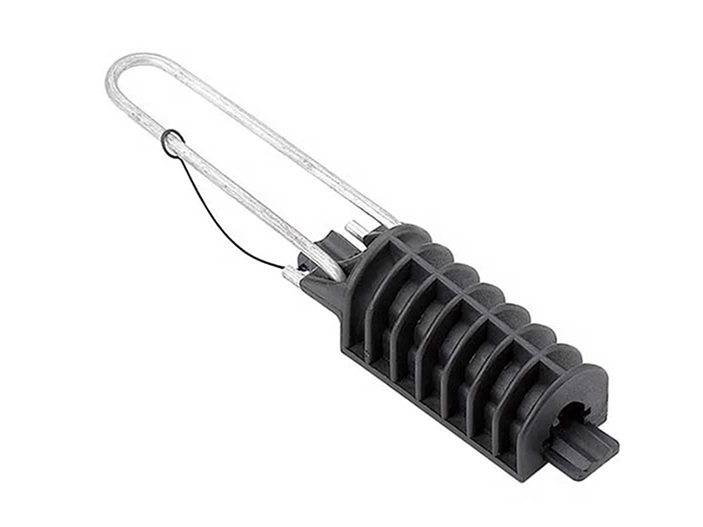
What Is a Dead End Clamp?
A dead end clamp is a mechanical fastening device used to anchor overhead cables at the end of a line, at sharp angles, or at pole transitions.
In four-core ABC systems, it grips the insulated phase conductors (and sometimes the neutral messenger) without damaging the insulation.
Primary Functions:
Withstand and transfer tensile forces
Prevent conductor slippage
Maintain cable alignment
Protect insulation from mechanical damage
Secure cables at poles, walls, or brackets
Why Four-Core ABC Cables Require Dead End Clamps
Four-core ABC cables are heavier and more complex than single-core lines. They contain:
Three phase conductors
One neutral conductor (which may be load-bearing)
Because ABC cables are bundled and insulated:
Tension must be evenly distributed
Insulation must not be pierced or crushed
Mechanical loads must not deform the conductors
Dead end clamps are specifically engineered to address these challenges while preserving electrical integrity.
How Dead End Clamps Secure Four-Core ABC Cables
3.1 Even Load Distribution
The clamp design ensures uniform gripping force across all four conductors, preventing:
Uneven tension stress
Core separation
Premature cable wear
Some designs use wedge systems that automatically tighten under load.
3.2 High Mechanical Strength
Dead end clamps are designed to handle:
Wind loads
Ice accumulation
Thermal expansion and contraction
Long-span mechanical stress
High-tensile galvanized steel or aluminum alloy components transfer load safely to the pole structure.
3.3 Insulation Protection
ABC cables rely on intact insulation for safety. Dead end clamps use:
UV-resistant polymer bodies
Smooth internal gripping surfaces
Controlled compression mechanisms
This prevents insulation cracking or cutting, which could otherwise cause short circuits.
3.4 Secure Anchoring at Termination Points
At the end of an overhead span, the entire mechanical tension is concentrated at one point. The dead end clamp:
Locks the cable in position
Transfers load to a pole bracket or anchor hook
Prevents longitudinal movement
Without it, the cable would gradually slip, sag, or detach.
Materials Used in Dead End Clamps
High-performance dead end clamps typically include:
Engineering plastics (UV-resistant, weatherproof)
Hot-dip galvanized steel hardware
Aluminum alloy tension elements
These materials ensure:
Corrosion resistance
Electrical insulation
Long service life in harsh environments
Installation Process Overview
A typical installation involves:
Positioning the clamp body around the ABC cable
Inserting wedge or tightening bolt system
Connecting clamp hook to a pole bracket
Applying proper tension
Correct installation ensures optimal gripping force and structural reliability.
Advantages of Using Dead End Clamps in ABC Systems
Improved system stability
Reduced risk of cable slippage
Enhanced safety due to insulation protection
Faster installation compared to traditional binding methods
Long-term mechanical reliability
Common Applications
Dead end clamps for four-core ABC cables are widely used in:
Urban and rural distribution lines
Street lighting systems
Service line connections
Industrial overhead power supply
Temporary power distribution networks
Conclusion
Dead end clamps play a fundamental role in securing four-core ABC cables in overhead installations. By combining mechanical strength, insulation protection, and reliable anchoring, they ensure long-term system stability and safety.
Proper selection and installation of dead end clamps guarantee that overhead ABC systems remain secure, efficient, and durable over years of service.
FAQ
1. What is the purpose of a dead end clamp?
A dead end clamp anchors four-core ABC cables at termination points, sharp angles, or pole transitions. It ensures cables remain secure, maintains alignment, and transfers mechanical tension to supporting structures.
2. How does a dead end clamp work?
The clamp grips the insulated conductors using wedge mechanisms, bolts, or compression systems. Tension from the suspended cable automatically tightens the grip, preventing slippage while protecting the insulation.
3. Can dead end clamps damage cable insulation?
High-quality dead end clamps are designed with smooth internal surfaces and controlled compression to avoid damaging the cable insulation. Proper installation further prevents any mechanical stress on the cores.
4. Are dead end clamps reusable?
Generally, reuse is not recommended. After initial installation, the mechanical gripping components may lose their full holding strength, which can compromise safety and reliability.
5. How do I choose the correct dead end clamp for my four-core ABC cable?
Key factors include:
Conductor cross-sectional area
Cable outer diameter
Required tensile strength
Environmental conditions (UV, humidity, temperature)
Installation type (pole, wall, or bracket)
6. What materials are commonly used in dead end clamps?
Engineering plastics (UV-resistant, weatherproof) for insulation
Galvanized steel for high tensile strength and corrosion resistance
Aluminum alloy for lightweight, durable anchoring
7. Can dead end clamps withstand extreme weather conditions?
Yes. Properly designed clamps are resistant to UV radiation, corrosion, ice load, high winds, and temperature fluctuations, ensuring reliable outdoor performance.
8. What happens if a clamp is undersized?
An undersized clamp may lead to cable slippage, excessive sag, insulation damage, or mechanical failure, which can cause service interruptions or safety hazards.