
Introduction
In the modern construction and maintenance of Aerial Bundled Cable (ABC) networks, selecting the correct line hardware is a decision that dictates the safety, longevity, and performance of the entire grid. While both Suspension Clamps and Dead End (Strain) Clamps are foundational components in overhead line engineering, they serve fundamentally different mechanical functions. Misapplying these components or confusing their operational limits is a leading cause of premature line failure, excessive conductor sagging, and costly infrastructure maintenance.
At SUNJ Electric, we have engineered our line hardware to exceed rigorous international standards. This comprehensive guide provides an in-depth analysis of when to utilize each component, the underlying engineering principles, material selection criteria, and the testing benchmarks that define their long-term reliabilit
The Mechanical Divide: Support vs. Tension
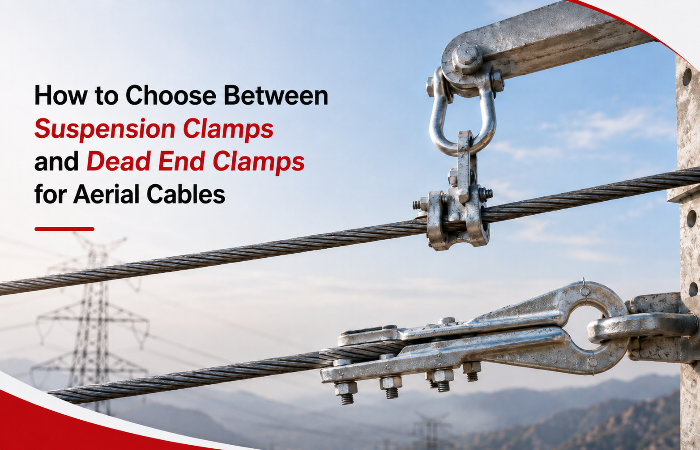
The core engineering distinction between suspension and dead-end hardware comes down to a simple yet vital rule: Suspension Clamps are designed for vertical support, whereas Dead End Clamps are engineered to manage extreme longitudinal tension.
A High-Durability Suspension Clamp is specifically designed to cradle the bundled conductor smoothly along a straight tangent run. It permits controlled longitudinal movement caused by thermal expansion and contraction while minimizing localized mechanical stress on the core. In direct contrast, Reliable Dead End Tension Clamps are anchored firmly at terminal points, sharp directional changes, and long river or valley crossings to absorb and hold the full mechanical pulling tension of the entire cable span.
Detailed Application: When and Why to Use a Suspension Clamp
Suspension clamps are primarily deployed on tangent poles where the utility route remains straight or features very gentle deviations. Their operational objectives include:
-
- Maintaining Proper Sag Profiles: Ensuring that the ABC cable maintains uniform ground clearance across varying temperatures and seasonal changes.
- Isolating Electrical Potential: Providing necessary insulation clearance from the supporting wooden, concrete, or steel utility poles.
- Mitigating Aeolian Vibration: Allowing slight, natural cable motions to dissipate harmlessly without transferring continuous fatigue cycles directly into the conductor strands.
-
Detailed Application: When and Why to Use a Dead End (Strain) Clamp
Whenever an overhead line terminates, changes direction significantly, or encounters a heavy mechanical span break, a dead-end clamp becomes mandatory. These robust anchoring units are built to:
- Secure Conductor Bundles Firmly: Utilizing wedge-type or bolted friction mechanisms to grip the messenger wire or neutral messenger securely without damaging internal insulation layers.
- Withstand Dynamic Environmental Loads: Managing high-velocity wind loads, ice accumulation weight, and sudden mechanical shocks that naturally concentrate at the dead-end structures.
- Prevent Longitudinal Slippage: Maintaining exceptional holding power under high tensile strain to ensure lines never slip or break free from terminal poles.
Engineering Criteria: Material Selection and Environmental Resilience
When procurement managers and electrical grid engineers select line hardware, material composition is just as important as mechanical design. Outdoor exposure subjects hardware to intense UV radiation, moisture, industrial pollution, and high salinity (in coastal zones).
To combat these factors, top-tier components rely on high-strength aluminium alloys, hot-dip galvanized steel brackets, and UV-stabilized engineering polymers. Utilizing specialized Mounting Brackets & Hooks ensures that the physical interface between the pole and the clamp remains structurally sound for decades, resisting corrosion and structural fatigue under heavy loads.
International Testing Standards: The Benchmark for Quality
Reliability in power distribution cannot be left to chance; it must be proven through standardized laboratory and field testing. SUNJ Electric products are manufactured and tested to comply with globally recognized standards, including IEC 61284 and NF C 33-040. These protocols mandate strict evaluations, such as:
- Mechanical Slip and Tensile Tests: Verifying that dead-end clamps can withstand specified percentages of the rated breaking load of the conductor without slipping.
- Environmental and UV Aging Tests: Simulating years of intense sunlight and thermal fluctuations to ensure polymer components do not become brittle or crack.
- Corrosion Resistance Testing: Subjecting metal hardware to salt-spray chambers to guarantee resistance to rust and oxidation in aggressive atmospheric environments.
Installation Challenges and Avoiding Common Errors
The most frequent failure in the field is not a product defect, but an installation oversight. Common errors include:
- Over-tightening: Can damage the cable insulation, leading to moisture ingress.
- Incorrect Bracket Selection: Using a light-duty bracket for a strain point leads to structural collapse.
- Ignoring Torque Specs: Always use a calibrated tool to tighten bolts to manufacturer specifications.
Need Project-Specific Support?
Choosing the wrong clamp can compromise your entire network. SUNJ Electric offers technical consultation to help you match our hardware with your specific ABC cable load requirements.
FAQ
- Q: Can a suspension clamp be used at a corner?
A: No. A strain/dead end clamp must be used at corners to manage the resulting tension. - Q: What happens if I use a cheap, non-standard clamp?
A: You risk premature fatigue, cable damage, and potential catastrophic line collapse. - Q: Are SUNJ brackets compatible with all utility poles?
A: We provide various bracket types to suit concrete, wooden, and steel poles. - Q: How do I test the tension of a dead end clamp?
A: Tension should be measured using calibrated dynamometers during installation. - Q: Why is UV resistance so important for clamps?
A: Outdoor exposure causes polymers to become brittle; high-quality UV stabilization prevents this degradation. - Q: How often should line hardware be inspected?
A: Periodic visual and mechanical checks should be performed annually as per utility best practices. - Q: Does torque affect clamp performance?
A: Yes, precise torque prevents both cable slippage and excessive crushing damage. - Q: What if my span is longer than standard?
A: We recommend heavy-duty strain clamps for long spans to accommodate higher tension loads. - Q: Are these clamps suitable for coastal/corrosive areas?
A: Yes, we use specialized anti-corrosion coatings for high-salinity environments. - Q: Where can I find the load ratings for SUNJ clamps?
A: Every product page on our website includes detailed mechanical specification tables.
Conclusion
The safe, reliable, and efficient management of modern aerial bundled cable networks relies heavily on the strategic and correct deployment of both suspension and dead-end hardware. By fully understanding the distinct mechanical roles of each clamp, respecting structural limits, and strictly adhering to international standards like IEC, utility providers can build resilient grids that minimize maintenance costs and downtime. At SUNJ Electric, we remain dedicated to supplying top-tier engineering expertise and robust hardware solutions for all your critical infrastructure projects.