
Key Takeaways
- A fuse cutout (drop-out fuse) protects a distribution transformer by isolating it from the feeder when overcurrent melts the fusible element.
- Size the fuse link near the transformer’s full-load current—typically 1.5×–2× FLA for distribution—to cover secondary faults without nuisance blowouts.
- Match the cutout voltage class and creepage distance to the line, and set the interrupting rating above the available fault current.
- SUNJ supplies high-voltage products including drop-out fuse cutouts for 10–38 kV overhead distribution networks.
Overview
A fuse cutout (drop-out fuse) protects a distribution transformer by melting its fusible element under overcurrent, isolating the transformer from the feeder. Correct selection matches the cutout voltage class and creepage to the line, sizes the fuse link near the transformer’s full-load current (typically 1.5–2× FLA for distribution), and sets an interrupting rating above the available fault current. Porcelain and polymer bodies serve different environments; loadbreak and arrester-combination types add switching and surge protection.
Why Transformer Protection Starts with the Cutout
A distribution transformer is one of the most expensive single assets on a feeder. When a fault occurs—whether from lightning, a downed conductor, insulation failure, or a secondary-side short—the transformer needs to be isolated quickly before thermal and mechanical stress destroys the winding. The fuse cutout is usually the first and most cost-effective line of defense.
Get the cutout wrong and you face one of two failures: a fuse sized too high that lets a fault cook the transformer, or a fuse sized too low that blows on harmless inrush and leaves customers in the dark. This guide walks utility buyers, EPC contractors, and distributors through the fuse cutouts for distribution transformer protection decision with a practical, specification-first approach.
SUNJ manufactures drop-out fuse cutouts and a full range of high-voltage products for overhead distribution. The guidance below reflects typical industry practice and common standards such as IEC 60282-2 and IEEE C37.41/42.
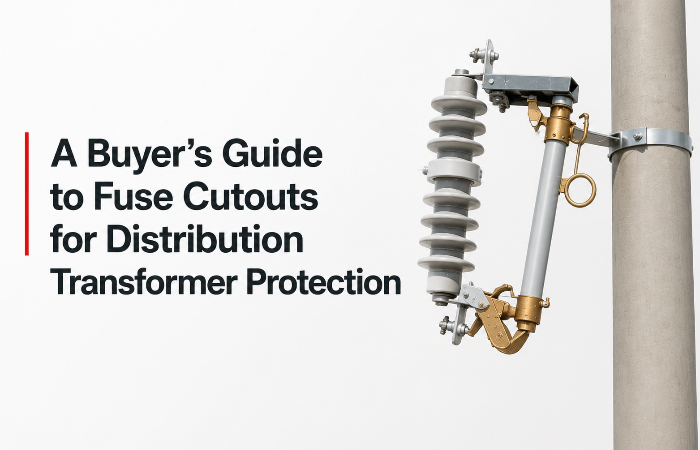
A Buyer’s Guide to Fuse Cutouts for Distribution Transformer Protection (2)
What Is a Fuse Cutout?
A drop-out fuse cutout is an open-air, outdoor disconnecting switch combined with a replaceable fuse link. It has three parts:
- Insulating body — the support structure, made of porcelain or polymer (silicone rubber on an FRP core).
- Contacts and hinge — the upper and lower terminals that hold the fuse tube in the conducting position.
- Fuse tube / element — the replaceable fuse link (silver or nickel-chrome element) that carries load current and melts on fault.
Under a fault, the element melts, the tube drops out by gravity (hence “drop-out”), giving a visible open point that field crews can see from the ground. This visible break is a major safety advantage during maintenance.
How a Fuse Cutout Protects a Transformer
The cutout is normally installed on the primary (high-voltage) side of the distribution transformer. It carries the transformer magnetizing and load current in normal operation. When an overcurrent exceeds the fuse-link rating long enough to melt the element, the arc is extinguished inside the tube and the tube drops, de-energizing the transformer.
Because high-quality fuse elements are “nondamageable”—their time-current characteristics stay accurate through age, vibration, and minor surges—you can fuse close to the transformer full-load current. That means the cutout can clear a broad range of secondary-side faults (which show up on the primary side, reflected by the turns ratio) while still riding through normal inrush.
Good fuse-link selection also supports system coordination: the transformer cutout should operate before the upstream feeder recloser or breaker for faults on the transformer or its secondary, limiting the outage to a single customer rather than a whole circuit.
7-Step Selection Checklist
Use this checklist to specify the right fuse cutout for a distribution transformer:
Step 1 — Confirm the line voltage class
Match the cutout’s rated voltage (e.g., 15 kV, 27 kV, 38 kV) to the system. Common distribution classes are 10–15 kV, 24–27 kV, and 33–38 kV.
Step 2 — Calculate transformer full-load current (FLA)
FLA (A) ≈ kVA × 1000 ÷ (√3 × kV_line). Example: a 500 kVA transformer on a 11 kV system draws about 26 A.
Step 3 — Size the fuse link
For distribution transformers, the fuse link is typically set around 1.5×–2× the FLA to cover secondary faults and through-faults while surviving inrush. Always verify against the manufacturer’s time-current curves and the transformer’s damage curve.
Step 4 — Set interrupting rating above available fault current
Confirm the cutout’s interrupting rating (commonly 12 kA symmetrical, up to 25 kA for larger units) exceeds the maximum fault current at the installation point.
Step 5 — Choose creepage distance for the environment
Polluted, coastal, or industrial sites need higher creepage (e.g., ≥ 400–900 mm for 24–38 kV). Under-specifying creepage invites tracking and flashover.
Step 6 — Pick the body material
Porcelain for standard, mechanically robust installations; polymer for lighter weight, hydrophobic performance, and easier handling in harsh or coastal zones.
Step 7 — Decide on type and standards
Choose loadbreak vs. non-loadbreak, and whether to add an arrester combination. Confirm compliance with IEC 60282-2 or IEEE C37.41/42 depending on the market.
Porcelain vs. Polymer Fuse Cutouts
| Attribute | Porcelain Body | Polymer Body |
|---|---|---|
| Material | Glazed alumina ceramic | FRP core + silicone rubber sheds |
| Weight | Heavier | Lighter, easier to install |
| Pollution resistance | Lower; needs cleaning in dirty areas | Higher; hydrophobic surface |
| Impact / breakage | Brittle, can shatter on impact | More impact-tolerant |
| Cost | Generally lower | Slightly higher |
| Best use | Clean, standard overhead lines | Coastal, polluted, high-altitude |
Loadbreak, Arrester-Combination & Other Types
- Non-loadbreak (general purpose): Standard drop-out cutout for protection and isolation; not intended to break load current.
- Loadbreak cutout: Adds an interrupting chamber so it can open under load—useful when the cutout also serves as a disconnect switch.
- Arrester-combination cutout: Integrates a surge arrester on the same mount for compact transformer surge + overcurrent protection in one assembly.
- Type L / interchangeable bodies: Designed to IEEE C37.41 interchangeability so fuse tubes and brackets swap across brands.
Typical Specification Ranges
| Parameter | Typical Range |
|---|---|
| Rated voltage | 10–38 kV |
| Continuous current (body) | 100 A / 200 A |
| Interrupting rating | 8–25 kA symmetrical |
| BIL (lightning impulse) | 110–170 kV (by voltage class) |
| Creepage distance | 220–900 mm (by pollution level) |
| Standards | IEC 60282-2, IEEE C37.41, IEEE C37.42 |
Exact values vary by manufacturer and design. Always confirm the published rating plate and time-current curves for the specific model you plan to purchase.
Common Sizing Mistakes
- Fusing too high — protects the fuse but not the transformer; faults clear too late and the winding fails.
- Fusing too low — nuisance blowouts (“sneakouts”) on inrush or minor surges, hurting service continuity.
- Ignoring creepage — under-specifying pollution distance causes tracking and flashover in coastal or industrial zones.
- Underestimating fault current — a cutout with too-low interrupting rating can fail to clear a severe fault safely.
- Skipping coordination — without checking TCCs against the upstream device, a single transformer fault can trip the whole feeder.
SUNJ Fuse Cutouts for Distribution
SUNJ supplies drop-out fuse cutouts and a complete portfolio of high-voltage products for overhead distribution transformer protection. Our cutouts are built to support reliable overcurrent protection with field-proven bodies and replaceable fuse links.
- Voltage coverage: 10–38 kV distribution classes.
- Material options: porcelain and polymer bodies for different environments.
- Quality systems: ISO 9001 and ISO 14001 certified manufacturing.
- Global logistics: overseas warehouse in Turkey for fast delivery and localized service.
- Application support: we help you match voltage class, fuse-link rating, creepage, and interrupting rating to your transformer and feeder.
Frequently Asked Questions
A fuse cutout is an outdoor disconnect switch with a replaceable fuse link, installed on the transformer’s primary side. On overcurrent, the element melts, the tube drops out, and the transformer is isolated from the feeder. For model advice, request a free quote from SUNJ.
Where is the fuse cutout installed relative to the transformer?
It is normally mounted on the primary (high-voltage) side, between the feeder and the transformer bushing. In pad-mount or substation arrangements it sits in the incoming compartment protecting the transformer from upstream faults.
How do I size the fuse link for a distribution transformer?
First calculate the transformer full-load current (FLA = kVA × 1000 ÷ √3 ÷ kV). For distribution, select a fuse link around 1.5×–2× FLA so it clears secondary faults yet survives inrush. Always verify with time-current curves.
What voltage and current ratings do I need?
Rated voltage must match the system (10–38 kV typical). The cutout body is usually 100 A or 200 A continuous, while the fuse link ampere rating is sized to the transformer as described above.
Porcelain vs. polymer fuse cutouts—which should I choose?
Porcelain is cost-effective for clean, standard lines and offers high mechanical robustness. Polymer is lighter, hydrophobic, and better for coastal, polluted, or high-altitude sites. Choose based on environment and handling constraints.
What is the difference between loadbreak and non-loadbreak cutouts?
Non-loadbreak cutouts only break fault current and must not open under load. Loadbreak cutouts include an interrupting chamber that safely opens load current, serving also as an operational disconnect switch.
What standards should fuse cutouts comply with?
Common standards are IEC 60282-2 for fuse links and IEEE C37.41 / C37.42 for cutouts and accessories. Select the standard required by your utility or national grid code. SUNJ products are built under ISO 9001 / ISO 14001 systems.
How do I coordinate the fuse with other protective devices?
Plot the fuse link’s time-current curve against the transformer damage curve and the upstream recloser or breaker curve. The cutout should clear transformer-zone faults first, limiting outages to a single transformer rather than the whole feeder.
What interrupting rating do I need?
The cutout’s interrupting rating must exceed the maximum available fault current at the installation point—commonly 12 kA for standard units, up to 25 kA for larger designs. SUNJ can confirm the rating for your fault level.
How do I request a quote for SUNJ fuse cutouts?
Email [email protected] or call +86 18875849654 with voltage class, transformer kVA, body material, and required standards. Our engineering team responds within 24 hours.
Conclusion
Selecting fuse cutouts for distribution transformer protection is a balance of voltage class, fuse-link sizing, interrupting rating, creepage, and coordination. The right cutout isolates faults fast, protects the transformer investment, and keeps outages small and rare.
Whether you run porcelain on clean rural feeders or polymer in coastal and polluted corridors, the fundamentals above apply. SUNJ supports buyers with standards-compliant drop-out fuse cutouts, technical selection help, and responsive global delivery.
As a manufacturer serving 80+ countries, we help utilities and contractors specify the correct insulation and protection solution for every line condition.
Related Resources
- SUNJ High-Voltage Products
- Aerial Cable Accessories
- Polymer Insulators vs. Porcelain Insulators: The Paradigm Shift in High-Voltage Lines
- How to Choose Between Suspension Clamps and Dead End Clamps for Aerial Cables
- About SUNJ Products
Need IEC- and IEEE-compliant fuse cutouts for your transformers?
SUNJ supplies drop-out fuse cutouts for 10–38 kV distribution networks, with porcelain and polymer options. Get a fast, customized quote from our engineering team.