
Introduction
An ADSS (All-Dielectric Self-Supporting) cable carries no metal strength member, so every mechanical load is taken by the cable fittings—the tension clamps, suspension clamps and vibration dampers that anchor and support it along the route. Specify the wrong fitting and you risk cable slip, aeolian-vibration fatigue, or even a dropped span. Unlike conventional conductor hardware, ADSS fittings must grip without crushing the delicate optical fibers inside.
This guide covers how to select ADSS tension and suspension clamps, how vibration dampers are chosen, and how to match the whole hardware set to cable diameter, span length and RTS (rated tensile strength).
ADSS vs OPGW, and the Role of the Fittings
Both ADSS and OPGW (Optical Ground Wire) are self-supporting optical cables, but ADSS is fully dielectric and needs no earthing, while OPGW doubles as the ground wire. The supporting hardware is similar:
- Tension (dead-end) clamp: anchors the cable at terminals, angle points and long spans, taking the full line tension.
- Suspension clamp: supports the cable at intermediate poles, allowing controlled movement to relieve vibration and thermal swing.
- Vibration damper: dissipates aeolian (wind-induced) vibration energy to protect the fiber from fatigue.
See the CS10 ADSS clamp bracket and the STA pole-drop dead-end clamp as typical examples from our range.
Selecting by Cable Diameter, Span and RTS
The fitting must be matched to three cable parameters, not just the line voltage:
| Parameter | How to use it |
|---|---|
| Cable diameter d (mm) | The clamp must list a matching nominal diameter range; an oversized grip crushes fibers, an undersized grip slips. |
| Span length (m) | Long spans → tension clamp with high grip; short, straight runs → suspension clamp. |
| RTS (rated tensile strength) | Tension clamp grip ≥ 10–20% of RTS; suspension clamp holding ≤ 15% of RTS to allow slip-free support. |
| Route geometry | Angle / dead-end points → tension; straight tangent sections → suspension. |
SUNJ ADSS Fitting Series
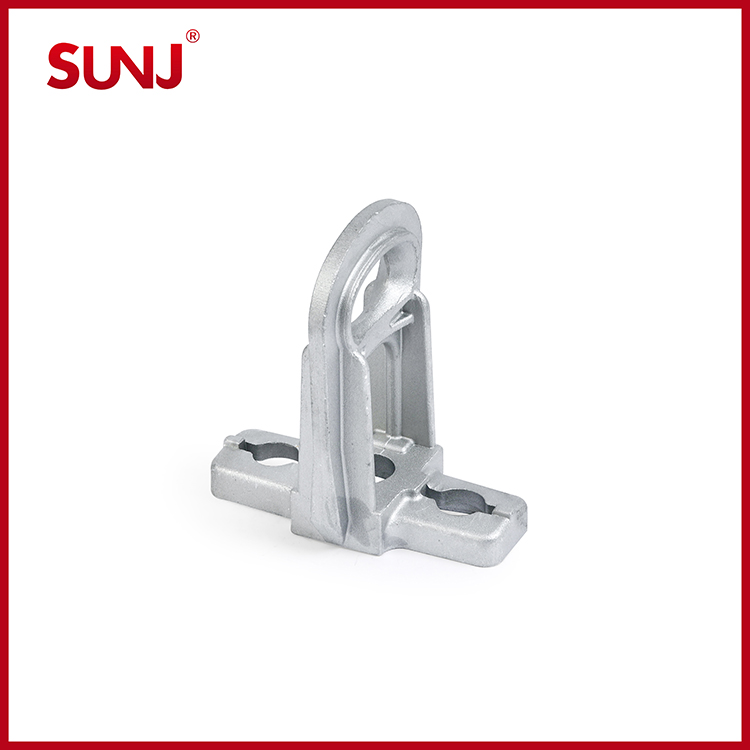
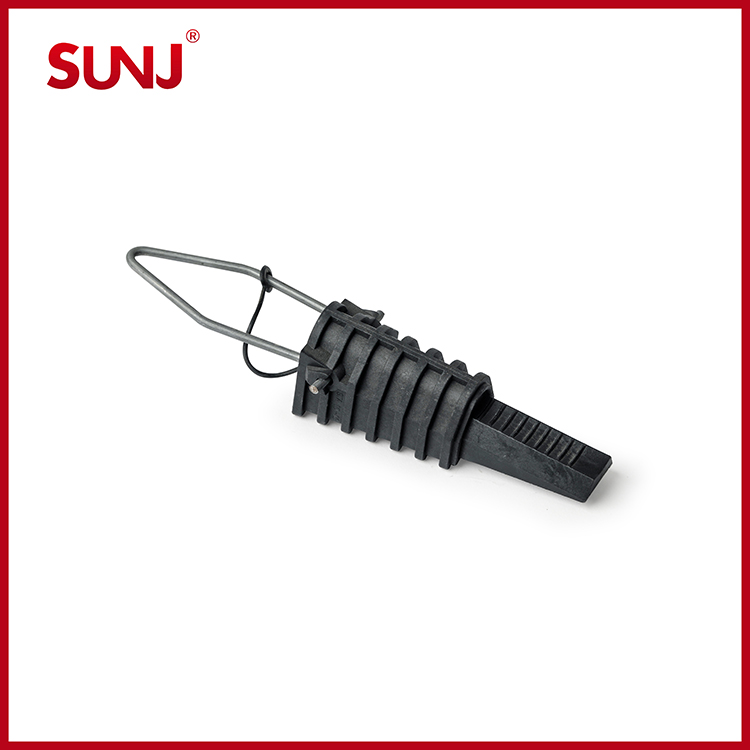
Our ADSS hardware covers the full bracket and clamp family:
- CS10 / CS20 brackets — CS10 ADSS clamp bracket and CS20 fiber-optic cable accessories for pole-side mounting.
- CS1200 / CS1300 tension brackets — CS1200 and CS1300 aluminium-alloy tension brackets for high-grip dead-ends.
- Suspension assemblies — PS-1500 and ES54-14 suspension assemblies with bracket.
- Drop-end anchoring — the STA pole-drop dead-end anchoring clamp for service drops.
Vibration Dampers: Stockbridge vs Spiral
| Type | Best for | Selection rule |
|---|---|---|
| Stockbridge damper | Long spans, large sag, high aeolian-vibration risk | Number & position set by span length and cable self-damping; usually 1–2 per span end |
| Spiral (rod) damper | Short spans, drops, accessory-level vibration | Wrapped directly on cable; length matched to cable diameter |
Both are selected together with the clamp set—dampers alone cannot compensate for a slipping tension clamp.
Which Fitting Where?
- Terminal / angle / long span: tension (dead-end) clamp — CS1200 / CS1300 brackets.
- Straight tangent pole: suspension assembly — PS-1500 or ES54-14.
- Service drop to building: STA pole-drop dead-end clamp.
- Every span ≥ ~100 m: add Stockbridge dampers; short drops use spiral dampers.
Installation & Sizing Checklist
- Measure the actual cable outer diameter and confirm the clamp diameter range.
- Read the cable data sheet for RTS and recommended suspension/tension grip ratios.
- Place tension clamps at terminals and every angle ≥ 15°; suspension clamps on straight runs.
- Fit vibration dampers per the span-vibration design (typically near each clamp).
- Set the correct wrapping length for spiral dampers; torque bracket bolts to spec.
- Verify no sharp bend radius < the cable’s minimum; confirm clamp does not crush the jacket.
FAQ
Q: Can I reuse an ADSS tension clamp?
A: No. Once gripped, the pre-formed or wedged body takes a set; reusing risks slip. Use new fittings each install.
Q: How do I know the clamp diameter?
A: Measure the cable OD with calipers and pick the clamp whose listed range covers it—never assume from the fiber count alone.
Q: Stockbridge or spiral damper?
A: Long, vibrating spans need Stockbridge; short drops and accessories use spiral rod dampers.
Q: Do ADSS fittings need earthing?
A: No—ADSS is dielectric. Only OPGW (which is the ground wire) is bonded to earth.
Q: Are CS brackets interchangeable between ADSS and OPGW?
A: Brackets are often shared, but the clamp body must match the specific cable construction; verify before mixing.
Conclusion
Selecting ADSS cable fittings is a mechanical problem first and an optical one second: match the clamp to the cable diameter and RTS, place tension clamps at load points and suspension clamps on tangents, and protect every span with the right vibration damper. Done correctly, an ADSS route runs maintenance-free for decades.
Need a bill of materials? SUNJ supplies the complete CS bracket and clamp family for ADSS and OPGW—CS10 / CS20 brackets, CS1200 / CS1300 tension brackets and PS-1500 / ES54-14 suspension assemblies. Browse the range or contact our engineers for a tailored fitting schedule.