
Introduction
In modern overhead power distribution, Aerial Bundled Cables (ABC) have become the preferred solution for low- and medium-voltage networks due to their safety, reliability, and simplified installation. However, maintaining mechanical stability and tension control is critical, especially at line terminations and sharp angle points.
This is where wedge type dead end clamps come into play. They are specially designed to anchor ABC cables securely, distribute mechanical load evenly, and protect cable insulation under demanding outdoor conditions.
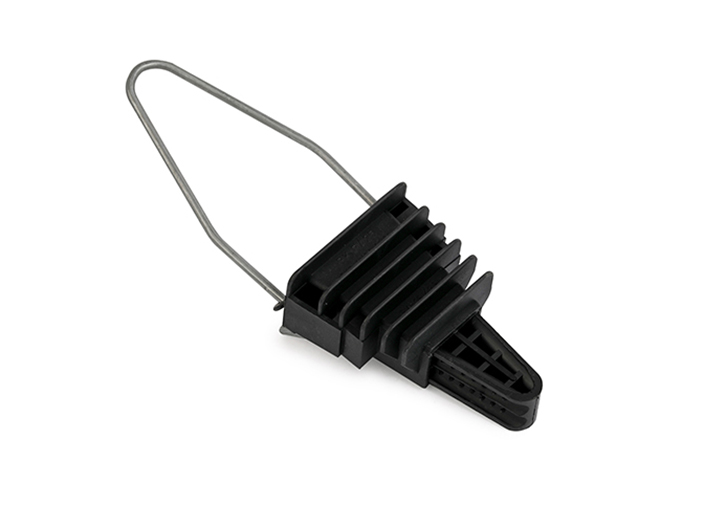
What Is a Wedge Type Dead End Clamp?
A wedge type dead end clamp is a mechanical fastening device used to anchor ABC cables at termination points, line angles, and pole connections.
Unlike conventional clamps, the wedge mechanism allows the clamp to self-tighten as cable tension increases. This ensures a stronger grip under load without damaging the cable insulation.
Primary Functions:
Secure ABC cables at poles, brackets, or junction points
Transfer mechanical tension safely to supporting structures
Maintain cable alignment and spacing
Protect conductors from movement, abrasion, or stress
Why ABC Cables Require Dead End Clamps
ABC cables consist of multiple insulated cores bundled together, often including a neutral messenger. Without proper anchoring:
Cables may slip under tension
Conductor cores may separate
Insulation can be damaged
Overhead lines can sag or fail under environmental stress
Wedge type dead end clamps are specifically engineered to address these challenges, ensuring both mechanical and electrical reliability.
How Wedge Type Clamps Work
The operation of a wedge type clamp relies on a self-locking wedge principle:
The ABC cable is inserted into the clamp body.
Internal wedges grip each conductor core gently but firmly.
As cable tension increases, the wedge tightens automatically.
The more tension applied, the stronger the grip becomes.
This design ensures that conductors are held securely while preserving insulation integrity.
Key Features and Advantages
4.1 Uniform Load Distribution
The wedge system distributes tension evenly across all cable cores, reducing stress on any single conductor and preventing insulation deformation.
4.2 High Mechanical Strength
Clamp bodies made of aluminum alloy, galvanized steel, or reinforced polymer provide strength to withstand:
Wind loads
Ice accumulation
Thermal expansion
Line vibration
4.3 Insulation Protection
Smooth wedge surfaces and precise gripping prevent abrasion or crushing of insulation, maintaining the ABC cable’s protective properties.
4.4 Easy Installation
Wedge type clamps often require minimal tools, simplifying installation for contractors and reducing labor costs.
4.5 Durable and Weather-Resistant
High-quality materials resist:
UV degradation
Corrosion
Extreme temperatures
Long-term environmental exposure
Applications in Overhead Installations
Wedge type dead end clamps are widely used in:
Urban and rural ABC distribution networks
Street lighting systems
Service entry connections
Industrial overhead cable installations
Temporary or emergency power lines
They are particularly effective at points where cables experience high tension or sharp directional changes.
Material Considerations
Effective wedge type clamps are made from:
Aluminum alloy – lightweight, strong, corrosion-resistant
Galvanized or stainless steel – high tensile strength and durability
UV-stabilized polymers – insulation protection, weather resistance
Proper material selection ensures long-term reliability under all environmental conditions.
Installation Guidelines
Select the clamp according to cable diameter, tensile load, and installation point.
Insert the ABC cable into the clamp body carefully.
Ensure wedges are aligned with each conductor core.
Attach the clamp to the pole bracket or anchor point.
Apply tension gradually to allow the wedge to self-lock.
Inspect the clamp to ensure a secure grip and no insulation damage.
Correct installation guarantees safety, long-term stability, and minimal maintenance.
Advantages Over Traditional Clamping Methods
Automatic tightening under tension
Reduced risk of conductor slippage
Protection of cable insulation
Lower installation labor and time
High mechanical and environmental durability
Conclusion
Wedge type dead end clamps are essential for securing ABC cables in overhead power lines. Their self-locking mechanism, insulation-friendly design, and robust construction make them ideal for modern low- and medium-voltage networks.
By ensuring proper tension, preventing slippage, and protecting insulation, these clamps contribute directly to system stability, safety, and long-term reliability in overhead installations.
FAQ
1. What is a wedge type dead end clamp?
A wedge type dead end clamp is a mechanical device used to anchor Aerial Bundled Cables (ABC) at termination points, line angles, or pole connections. It grips the cable securely using a wedge mechanism that tightens under tension, preventing slippage while protecting insulation.
2. How does a wedge type clamp work?
The clamp uses internal wedges to hold each conductor core of the ABC cable. As tension on the cable increases, the wedges tighten automatically, distributing load evenly across all cores and maintaining secure anchoring.
3. Can wedge type clamps damage cable insulation?
No. Properly designed wedge type clamps have smooth surfaces and controlled compression, which prevents crushing or abrasion of cable insulation while maintaining a firm grip
4. Where are wedge type dead end clamps typically used?
Urban and rural ABC distribution networks
Street lighting lines
Industrial overhead cable installations
Service entry connections
Termination points and sharp line angles
5. What materials are used in wedge type dead end clamps?
Aluminum alloy – lightweight, corrosion-resistant
Galvanized or stainless steel – high tensile strength
UV-stabilized polymers – insulation protection and weather resistance
Material selection ensures durability and long-term performance.
6. Are wedge type clamps suitable for extreme weather?
Yes. High-quality wedge clamps resist UV radiation, corrosion, ice accumulation, high winds, and temperature fluctuations, making them suitable for outdoor installations in harsh environments.