
Introduction
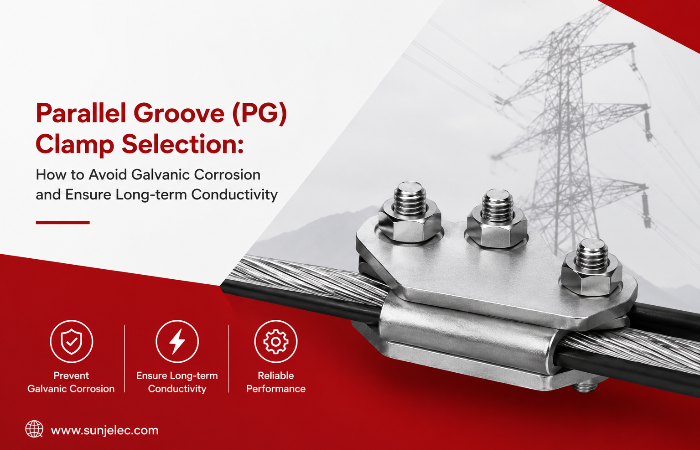
In power transmission and distribution, the efficiency and safety of your overhead line are determined entirely by the reliability of every single connection. Choosing the correct Parallel Groove (PG) Clamp is not just a matter of matching physical dimensions—it is about ensuring long-term electrical stability, maintaining low contact resistance, and actively preventing catastrophic network failures caused by thermal overload and galvanic corrosion.
At SUNJ Electric, we provide a wide range of robust engineering solutions, from high-performance bimetallic PG clamps to heavy-duty aluminium connectors. In this comprehensive technical guide, we break down everything engineers and procurement managers need to know to select, install, and maintain the right parallel groove clamps for specific project requirements.
The Challenge of Material Compatibility
One of the most common and damaging mistakes in overhead line installation is utilizing a standard aluminium clamp to interconnect copper and aluminium conductors. When dissimilar metals come into direct contact in an outdoor environment, it triggers galvanic corrosion. This electrochemical reaction rapidly degrades the contact interface, introduces high electrical resistance, causes localized overheating, and can ultimately lead to complete line burnout or dropped conductors.
To completely eliminate this risk, engineers must always prioritize Bimetal PG Clamps (such as our advanced SLPG series or high-integrity CAPG series) whenever a project involves mixed-metal conductors. These specialized connectors are engineered with a friction-welded or metallurgically bonded transition zone that creates a stable, corrosion-free electrical bridge between copper and aluminium lines.
Selecting Based on Load and Mechanical Stress
Not all clamps are designed for the same stress levels. For heavy-duty transmission lines where vibration and high load are factors, we recommend our Heavy Duty H Type Aluminium Parallel Groove Clamp. Its design provides superior clamping force and maintains consistent contact pressure even under extreme environmental conditions.
Need to Match Your Cable Specs?
Do you have specific conductor sizes or mixed-metal requirements? Our team can provide a technical recommendation and load capacity data for your specific project.
Comparative Matrix: Choosing the Right Parallel Groove Clamp
To simplify the selection process for site engineers and procurement teams, the following comparison matrix outlines the ideal applications, material traits, and structural advantages of our core parallel groove clamp variants:
| Clamp Series | Conductor Compatibility | Primary Application | Key Structural Advantage |
|---|---|---|---|
| Standard APG Series | Aluminium to Aluminium | General low & medium voltage distribution | Cost-effective, high-conductivity forged alloy body. |
| Bimetal SLPG / CAPG | Copper to Aluminium | Substations and mixed-conductor transition lines | Prevents galvanic corrosion via a bonded copper-aluminum pad. |
| H-Type Heavy Duty | Aluminium / All-Aluminium Alloy | High-load transmission and vibration-prone spans | Unmatched mechanical clamping pressure and creep resistance. |
Advanced Engineering Criteria for Long-Term Grid Reliability
When evaluating parallel groove connectors for large-scale utility infrastructure, procurement specialists must look beyond the initial purchase price. High-performance clamps require strict adherence to metallurgical purity and manufacturing precision. Low-grade aluminium alloys are prone to “creep”—a gradual physical deformation under sustained mechanical and thermal stress that causes bolts to loosen over time. SUNJ Electric utilizes high-strength, heat-treated aluminium alloy extrusions that maintain structural memory and consistent tension over decades of exposure.
Best Practices for Installation and Maintenance
Even the most advanced parallel groove clamp will underperform if field installation procedures are compromised. To guarantee optimal electrical conductivity and mechanical stability, technicians should always observe the following best practices:
- Surface Preparation: Clean oxide layers thoroughly from aluminium conductors using a wire brush immediately before installing the clamp.
- Torque Calibration: Always utilize a calibrated torque wrench. Under-tightening results in high resistance arcing, while over-tightening can crush inner conductor strands.
- Corrosion Inhibition: Ensure contact grease is properly applied inside the grooves to seal out moisture and prevent long-term surface oxidation.
Need to Match Your Specific Cable Specs?
Do you have complex conductor sizes, unique span lengths, or mixed-metal requirements? Our engineering team can provide customized technical recommendations and certified load capacity data for your project.
FAQs
- Q: Why is a Bimetal PG Clamp necessary for Cu-Al connections?
A: It prevents electrochemical reaction (galvanic corrosion) between different metals, ensuring the connection remains conductive for years. - Q: How do I choose between APG and H-Type clamps?
A: APG is ideal for general distribution, while H-Type is engineered for heavy-duty applications with higher mechanical demands. - Q: Can PG clamps be used to support cable tension?
A: No. PG clamps are for electrical connection; they should not be used as dead-end tensioning devices. - Q: What is the benefit of the grooves in the clamp body?
A: The grooves are precision-engineered to provide maximum surface contact area with the conductor. - Q: Do these clamps come pre-greased?
A: Many of our PG clamps feature contact grease to inhibit oxidation and improve moisture resistance. - Q: Are SUNJ PG clamps suitable for live-line installation?
A: Yes, our designs are optimized for utility-standard installation procedures. - Q: How do I know if I have tightened the clamp enough?
A: Always use a torque wrench and adhere to the specific tightening values provided in our technical documentation. - Q: Can I use a PG clamp for a single-conductor branch?
A: Yes, provided the groove size matches the conductor diameter accurately. - Q: Why is alloy selection important?
A: High-strength aluminium alloys ensure the clamp does not undergo “creep” or loosening over time due to thermal expansion. - Q: How does the SUNJ design differ from generic clamps?
A: We focus on high-conductivity alloy purity and standardized thread precision for reliable, repeatable torque application.
Conclusion
The selection and deployment of parallel groove clamps directly dictate the uptime, safety, and efficiency of power distribution networks. By prioritizing material compatibility, selecting appropriate load-rated designs, and enforcing strict installation standards, utilities can drastically reduce failure rates. SUNJ Electric remains fully committed to supplying durable, high-conductivity components built for the demands of modern infrastructure.