
Introduction
Understand the material, performance, and cost differences driving utilities worldwide to adopt composite polymer insulators over traditional porcelain.
By SUNJ Electric | July 29, 2026
Key Takeaways
- Polymer insulators combine a fiberglass-reinforced plastic (FRP) core with silicone rubber sheds, delivering a lightweight, hydrophobic, and impact-resistant design.
- Porcelain insulators are sintered ceramic with high compressive strength but are brittle, heavy, and prone to pollution flashover in contaminated environments.
- Modern grids favor polymer for heavy pollution, coastal salt fog, high altitude, and seismic or high-wind zones because of lower maintenance and longer service life.
- SUNJ supplies IEC-tested polymer insulators and a full range of high-voltage products for transmission and distribution projects.
About SUNJ
Zhejiang Sunj Electric Co., Ltd. is a power transmission and distribution manufacturer with 15+ years of experience, ISO 9001 and ISO 14001 certifications, and products approved to IEC 61238, IEC 61284, and NFC 33042 standards. Learn more About SUNJ products.
Why the Insulator Choice Matters
In overhead transmission and distribution networks, insulators do two things simultaneously: they keep energized conductors electrically isolated from grounded towers, and they carry the mechanical tension or bending load of the conductor. A failure in either function causes outages, safety risks, and costly emergency repairs.
For decades, porcelain insulators were the default choice. Today, however, grid owners and EPC contractors are increasingly specifying polymer insulators—also called composite insulators—for new lines and refurbishments. The change is not just a materials trend; it is a genuine paradigm shift shaped by performance data, lifecycle economics, and tougher environmental conditions.
This guide compares polymer insulators vs porcelain insulators across the criteria that matter most to utility engineers and procurement teams: material composition, mechanical behavior, electrical performance, maintenance burden, and total cost of ownership.
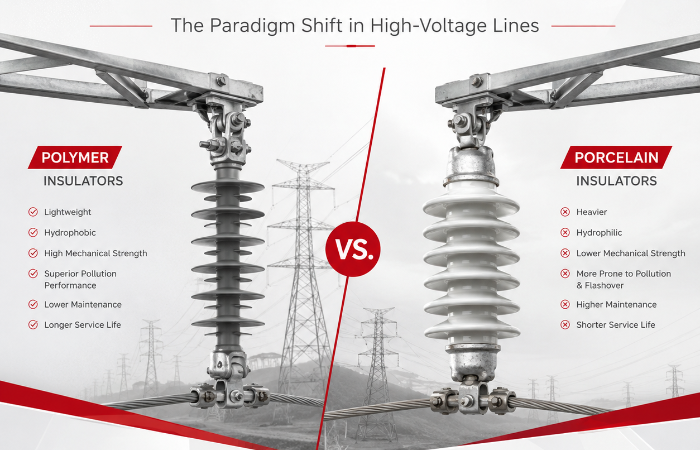
Polymer Insulators vs. Porcelain Insulators The Paradigm Shift in High Voltage Lines
What Are Polymer Insulators?
A polymer insulator is a composite structure. Its load-bearing core is a fiberglass-reinforced plastic (FRP) rod, which provides high tensile strength and excellent flexibility. The rod is protected by silicone rubber sheds and housing, which provide electrical insulation, UV resistance, and hydrophobicity. Metal end fittings are crimped or bonded to the core to connect conductors and hardware.
The silicone rubber surface repels water and allows hydrophobic migration, meaning contamination layers on the surface do not easily form continuous conductive films. This property dramatically reduces the risk of pollution flashover in humid or dirty environments.
Common designs include suspension, tension, post, pin, and line-post types, covering voltage classes from 10 kV up to 500 kV and above.
What Are Porcelain Insulators?
Porcelain insulators—also called ceramic insulators—are manufactured from high-purity alumina clay, shaped, glazed, and fired at very high temperatures. The result is a hard, dense, dielectric body with excellent compressive strength and long-term electrical stability under clean conditions.
The porcelain surface is hydrophilic, however, so moisture and contaminants tend to form conductive films. In polluted or coastal areas, this can lead to pollution flashover unless the insulators are cleaned regularly. Porcelain is also brittle; impact during transport, installation, or ice shedding can crack or shatter the body.
Despite these limitations, porcelain remains a proven option for clean environments, large-span applications where compressive strength is critical, and legacy systems where operators prefer to maintain material consistency.
Polymer vs. Porcelain: Side-by-Side Comparison
| Attribute | Polymer Insulators | Porcelain Insulators |
|---|---|---|
| Material | FRP core + silicone rubber sheds/housing | Sintered alumina porcelain ceramic |
| Weight | 1/5 to 1/3 of porcelain; easier handling | Heavy; increases tower load and logistics cost |
| Mechanical Strength | High tensile strength; flexible; impact-resistant | High compressive strength; brittle under impact |
| Pollution Performance | Excellent; hydrophobic surface resists flashover | Poor in polluted conditions; needs frequent cleaning |
| Typical Service Life | 20–30 years | 15–25 years (shorter in harsh environments) |
| Maintenance | Low; mainly visual inspection | High; periodic washing and crack inspection |
| Initial Cost | Higher unit cost | Lower unit cost |
| Total Cost of Ownership | Lower due to reduced maintenance and longer life | Higher in polluted or coastal areas |
| Best Applications | Polluted areas, coastlines, high altitude, high wind | Clean rural areas, legacy lines, large spans |
The comparison table shows that the polymer insulators vs porcelain insulators decision is not about absolute superiority. It is about matching the insulator’s material strengths to the operating environment and lifecycle priorities of the project.
Why the Shift to Polymer Is Accelerating
Several forces are driving the paradigm shift from porcelain to polymer in high-voltage lines:
1. Harsher Environmental Conditions
Industrial pollution, coastal salt fog, desert dust, and acid rain all increase the risk of pollution flashover. Polymer insulators tolerate these conditions better because silicone rubber maintains hydrophobicity and recovers it over time.
2. Reduced Maintenance Burden
Utilities face pressure to cut O&M costs and minimize live-line work. Polymer insulators require only periodic visual inspection, while porcelain systems in polluted regions need scheduled washing and replacement of chipped units.
3. Logistics and Installation Efficiency
At one-fifth to one-third the weight of porcelain, polymer insulators reduce freight costs, simplify tower loading calculations, and speed up installation—especially in mountainous or remote terrain where helicopter stringing is required.
4. Vibration and Impact Resistance
The FRP core absorbs wind-induced vibration and mechanical shock better than brittle ceramic. This is a significant advantage in high-wind corridors and seismic zones.
SUNJ Polymer Insulators: Built for Modern Grids
SUNJ manufactures polymer insulators and a complete portfolio of high-voltage products for transmission and distribution networks. Our composite insulators are designed to meet the mechanical, electrical, and environmental demands of modern grid infrastructure.
- Proven materials: High-strength FRP rods and UV-stable silicone rubber housing.
- Standards compliance: Products certified to IEC 61238, IEC 61284, and NFC 33042.
- Quality systems: ISO 9001 quality management and ISO 14001 environmental management.
- Global logistics: Overseas warehouse in Turkey for fast delivery and localized service.
- Application range: 10 kV through 500 kV overhead lines, including polluted and coastal environments.
Whether you are specifying a new transmission line or retrofitting an existing one, SUNJ can recommend the right polymer insulator type, shed profile, and creepage distance for your voltage class and environmental conditions.
Application Guidelines
Use the checklist below to match the insulator type to your project conditions:
| Project Condition | Recommended Insulator |
|---|---|
| Heavy industrial pollution or coastal salt fog | Polymer / composite insulator |
| High altitude, low air pressure | Polymer / composite insulator |
| High wind or seismic exposure | Polymer / composite insulator |
| Clean rural or desert environments | Porcelain or polymer |
| Large river crossings or heavy compression loads | Porcelain or engineered polymer |
| Retrofit with minimal tower loading increase | Polymer / composite insulator |
Frequently Asked Questions
What is the main difference between polymer and porcelain insulators?
Polymer insulators use an FRP core and silicone rubber housing, making them lightweight, flexible, and hydrophobic. Porcelain insulators are solid ceramic, strong in compression but heavy, brittle, and hydrophilic. For project-specific guidance, request a free quote from SUNJ.
Are polymer insulators better than porcelain insulators?
Polymer insulators outperform porcelain in polluted, coastal, high-wind, and high-altitude environments and offer lower lifecycle costs. Porcelain remains competitive in clean environments and applications requiring high compressive strength.
Why are polymer insulators also called composite insulators?
The term “composite” refers to the combination of multiple materials—FRP core, silicone rubber housing, and metal end fittings—working together as one functional unit. Each material is selected for a specific mechanical or electrical role.
What voltage range are polymer insulators suitable for?
Polymer insulators are widely used from 10 kV distribution up to 500 kV and extra-high-voltage transmission lines. SUNJ supplies polymer insulators across this range with appropriate creepage and mechanical ratings.
How long do polymer insulators last?
Well-manufactured polymer insulators typically achieve a service life of 20–30 years, often exceeding comparable porcelain units in harsh environments. Lifespan depends on material quality, UV exposure, and electrical stress.
Are polymer insulators good for coastal or polluted areas?
Yes. Silicone rubber hydrophobicity prevents water films from forming over contamination layers, which is the primary cause of pollution flashover. This makes polymer insulators ideal for coastal salt fog and industrial pollution zones.
Do polymer insulators require special testing?
Polymer insulators share common electrical and mechanical tests with porcelain types but add specific checks such as shed adhesion, interface sealing, and hydrophobicity evaluation. SUNJ products are tested to IEC standards before shipment.
Can polymer insulators replace porcelain insulators in existing lines?
In most cases, yes. Because polymer insulators are lighter and often have similar or longer creepage distances, they can be direct replacements. Always verify mechanical load ratings, interface dimensions, and electrical clearances before retrofitting.
What standards do SUNJ polymer insulators meet?
SUNJ holds ISO 9001 and ISO 14001 certifications, and our products conform to IEC 61238, IEC 61284, and NFC 33042 standards. Download specifications or contact our engineers for detailed test reports.
How do I request a quote for polymer insulators from SUNJ?
Email [email protected] or call +86 18875849654 with your voltage class, insulator type, quantity, and environmental conditions. Our team will respond within 24 hours.
Conclusion
The polymer insulators vs porcelain insulators debate is increasingly resolved by operating environment and lifecycle economics rather than tradition. Porcelain still has a place in clean, low-vibration applications, but polymer insulators are becoming the default for modern high-voltage lines exposed to pollution, salt fog, high altitude, and severe weather.
For utilities, contractors, and distributors evaluating a new line or retrofit, the evidence points toward composite polymer technology as the safer, lighter, and more cost-effective long-term choice.
SUNJ is ready to support your project with IEC-tested polymer insulators, technical selection guidance, and responsive global logistics. As a trusted manufacturer serving 80+ countries, we help you specify the right insulation solution for your grid.
Conclusion
The polymer insulators vs porcelain insulators debate is increasingly resolved by operating environment and lifecycle economics rather than tradition. Porcelain still has a place in clean, low-vibration applications, but polymer insulators are becoming the default for modern high-voltage lines exposed to pollution, salt fog, high altitude, and severe weather.
For utilities, contractors, and distributors evaluating a new line or retrofit, the evidence points toward composite polymer technology as the safer, lighter, and more cost-effective long-term choice.
SUNJ is ready to support your project with IEC-tested polymer insulators, technical selection guidance, and responsive global logistics. As a trusted manufacturer serving 80+ countries, we help you specify the right insulation solution for your grid.
Related Resources
- SUNJ High-Voltage Products
- Aerial Cable Accessories
- How to Choose Between Suspension Clamps and Dead End Clamps for Aerial Cables
- Copper vs. Aluminum vs. Bimetal Lugs: The Engineering Choice for Reliable Connections
- About SUNJ Products
Need IEC-tested polymer insulators for your next project?
SUNJ supplies composite insulators and high-voltage products for 10 kV–500 kV lines. Get a fast, customized quote from our engineering team.