
Introduction
In modern aerial distribution networks, the efficiency of your Aerial Bundled Cable (ABC) system is only as good as its weakest connection. Choosing the right Insulation Piercing Connector (IPC) is more than a purchase—it is a critical engineering decision that affects network reliability and maintenance costs.
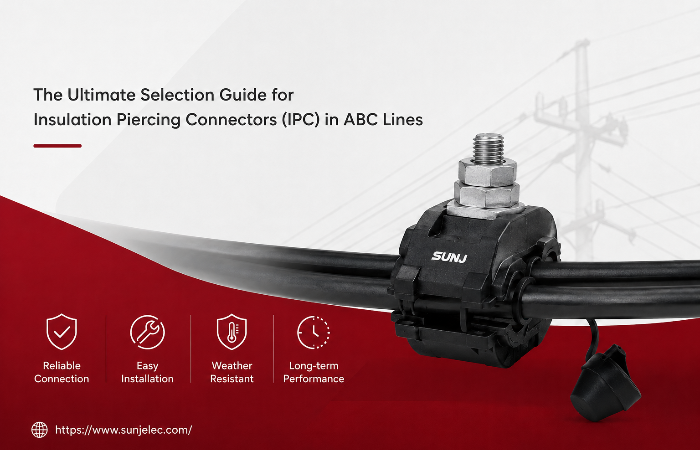
At SUNJ Electric, we understand that electrical engineers and procurement managers prioritize both safety and longevity. This guide outlines the key technical criteria for selecting top-tier IPC clamps for your next infrastructure project.
Understanding the Core Design: How IPCs Work
The magic of an IPC lies in its piercing teeth. When the bolt is tightened, these teeth penetrate the insulation to establish a perfect electrical contact with the conductor, while the polymer body ensures a fully insulated, watertight seal.
Key benefits include:
-
No Stripping Required: Minimizes cable damage and installation time.
-
Watertight Integrity: Protects the connection from oxidation and environmental stress.
-
Safety: The bolt is insulated, allowing for installation on live lines (under specific safety protocols).
Key Selection Criteria
When comparing IPC models (like those from major manufacturers), focus on these four technical pillars:
A. Conductor Range & Compatibility
Not all IPCs are universal. Ensure the connector matches:
-
Main Line & Tap Line Size: The connector must accommodate the cross-section (mm²) of both cables.
-
Material Compatibility: Copper to Copper, Aluminum to Aluminum, or Bi-metallic (Al-Cu). Using the wrong material combination can lead to galvanic corrosion.
B. Torque Control (Shear-Head Bolts)
The most critical feature of a high-quality IPC is the shear-head bolt.
-
It ensures the perfect amount of pressure is applied to pierce the insulation without damaging the conductor strands.
-
Once the correct torque is reached, the head snaps off, providing a clear visual indication that the installation is complete.
C. Environmental Durability
Since ABC lines are exposed to weather, check for:
-
UV Resistance: Ensure the plastic body is climate-rated.
-
Corrosion Resistance: Look for grease-filled contact areas to prevent water ingress.
D. Simultaneous Tightening vs. Single Bolt
Some high-end connectors (like those used in professional utility projects) feature simultaneous tightening for both the main and tap lines, ensuring a balanced, secure connection in one step
The Importance of Torque Control (Shear-Head Bolts)
The “piercing” capability is useless if the pressure is inconsistent. Professional-grade IPCs utilize shear-head bolts. As you tighten the bolt, it snaps off once the factory-calibrated torque is reached. This ensures the teeth penetrate the insulation precisely without crushing the conductor strands.
Installation Best Practices
Selecting the right connector is only half the battle. To ensure a 20+ year lifespan:
-
Clean the surface: Remove debris from the cable surface before mounting.
-
Use the right tools: Always use a proper socket wrench; avoid impact drivers that can damage the bolt prematurely.
-
Check the sequence: If installing on live lines, always follow the specific utility’s safety procedures regarding PPE and insulated tools.
Environmental Durability & UV Resistance
ABC lines are exposed to harsh weather conditions. An inferior IPC body will become brittle under constant UV exposure, leading to micro-cracks and water ingress. Ensure your selected IPC is manufactured from high-strength, weather-resistant thermoplastic to guarantee long-term watertight integrity.
Need Support
Need Project-Specific Support?
Selecting the right hardware for complex power projects can be challenging. Our engineering team is here to assist with technical specifications and load calculations.
FAQs
- Q: What is the primary advantage of an IPC over a split-bolt connector?
A: IPCs eliminate the need for cable stripping, significantly reducing installation time and preventing moisture ingress. - Q: Can I use an IPC for both LV and MV lines?
A: IPCs are generally designed for specific voltage classes; always check the manufacturer’s rating. - Q: How do I identify a high-quality IPC?
A: Look for shear-head bolts, UV-stabilized materials, and certification to international standards like IEC. - Q: Why does my IPC have a grease-filled cap?
A: The grease provides a watertight seal, preventing oxidation at the piercing contact point. - Q: Is it safe to install IPCs on live lines?
A: Yes, if the connector is specifically rated for live-line work and you follow standard utility PPE protocols. - Q: Can the bolt be reused?
A: No. Once the shear-head breaks, the structural integrity of the bolt is set for a single installation. - Q: How do I match the main and tap line sizes?
A: Consult our IPC product catalog for specific cross-section ranges (mm²). - Q: Does the material of the piercing teeth matter?
A: Yes, the teeth must be made of high-conductivity, corrosion-resistant alloy to ensure stable electrical contact. - Q: What happens if I over-tighten the bolt?
A: If you don’t use a shear-head bolt, you risk crushing the cable, which leads to overheating and potential circuit failure. - Q: How often should IPC connections be inspected?
A: They should be checked during scheduled line maintenance, usually annually or per utility regulations.
Conclusion:
Selecting the right Insulation Piercing Connector for your ABC line project directly impacts maintenance costs and network reliability. Whether you are dealing with high-voltage distribution or low-voltage service lines, prioritizing certified shear-head technology and material compatibility is non-negotiable.
Need technical specifications for your specific cable size or project requirements?