
Introduction
Overhead power lines are a critical part of modern electrical infrastructure, widely used for transmitting and distributing electricity across cities, industrial zones, and rural areas. To ensure their stability, safety, and long-term performance, various mechanical components are required. Among the most important are suspension clamps, strain clamps, and tension clamps.
Although they may appear similar, each type of clamp serves a unique function within the system. Understanding their roles helps improve installation efficiency, operational reliability, and overall network safety.
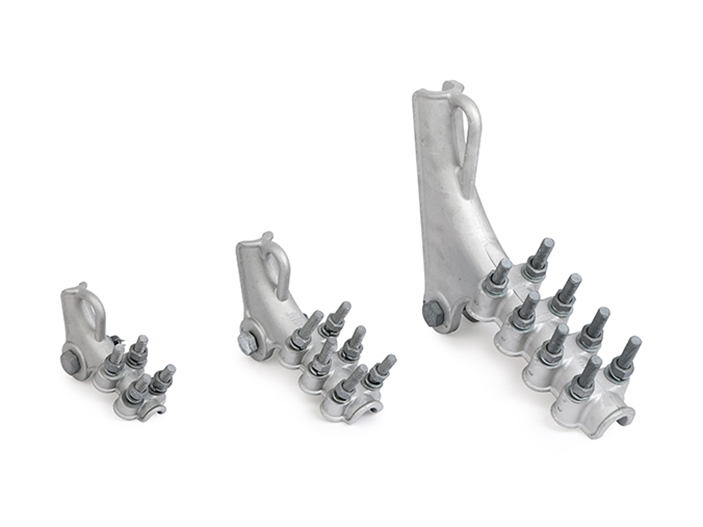
What Is a Suspension Clamp?
A suspension clamp is designed to support and suspend conductors along straight sections of an overhead line.
Key Functions:
Holds the conductor securely on intermediate poles or towers
Allows limited movement to accommodate wind and thermal expansion
Reduces mechanical stress on the cable
Typical Applications:
Straight-line sections of overhead distribution lines
Medium- and low-voltage systems
Aerial Bundled Cable (ABC) installations
Design Features:
Made from aluminum alloy or high-strength polymer
Grooved design to protect conductor insulation
Built for flexibility and vibration resistance
Importance:
Suspension clamps help maintain proper conductor positioning while minimizing wear caused by environmental factors.
What Is a Strain Clamp?
A strain clamp is used where the conductor is subjected to high mechanical tension, such as at the end of a line or at angle points.
Key Functions:
Anchors the conductor firmly to poles or towers
Withstands high tensile forces
Prevents conductor slippage
Typical Applications:
Dead-end poles or line terminations
Sharp directional changes in the line
Design Features:
High-strength materials such as galvanized steel or reinforced plastic
Strong gripping mechanism to prevent slipping
Excellent resistance to corrosion and weather
Importance:
Strain clamps are essential for maintaining structural integrity and preventing failures under heavy load conditions.
What Is a Tension Clamp?
A tension clamp is used to manage and maintain the correct tension in overhead conductors, especially over long spans.
Key Functions:
Controls and balances conductor tension
Distributes mechanical loads evenly
Prevents excessive sagging
Typical Applications:
Long-span transmission lines
High-load or high-stress environments
Areas with strong wind, ice, or temperature variations
Design Features:
Engineered for accurate load distribution
Compatible with insulators and other fittings
Durable construction for long-term use
Importance:
Tension clamps ensure that conductors remain stable and properly tensioned, improving system reliability and efficiency.
Key Differences Between the Three Clamp Types
| Feature | Suspension Clamp | Strain Clamp | Tension Clamp |
| Main Function | Support conductor | Anchor conductor | Control tension |
| Installation Point | Intermediate poles | Line ends / angle نقاط | Long spans / high-load areas |
| Load Capacity | Low to moderate | High | Controlled high load |
| Movement Allowance | Flexible | Minimal | Limited |
How They Work Together
In a complete overhead line system, these clamps function as a coordinated system:
Suspension clamps support the conductor along straight sections
Strain clamps secure the conductor at endpoints and direction changes
Tension clamps maintain consistent mechanical balance across spans
Together, they:
Reduce mechanical stress
Prevent conductor sagging
Enhance safety and durability
How to Choose the Right Clamp
When selecting the appropriate clamp type, consider:
Conductor size and type
Mechanical load requirements
Environmental conditions (wind, temperature, corrosion)
Installation position (straight line, angle, or termination)
Compliance with industry standards
Choosing the correct clamp ensures both performance and long-term reliability.
Conclusion
Suspension, strain, and tension clamps are small but vital components in overhead power line systems. Each plays a specific role—supporting, anchoring, or managing tension—while working together to ensure safe and efficient power transmission.
As electrical networks continue to expand and modernize, selecting high-quality, well-designed clamps is essential for building reliable and resilient infrastructure.
FAQ
1. Are strain clamps and tension clamps the same?
They are closely related and sometimes used interchangeably, but strain clamps focus on anchoring, while tension clamps are designed for managing and balancing loads.
2. Can suspension clamps handle high tension?
No, suspension clamps are designed for support, not for high tensile loads.
3. What materials are commonly used?
Common materials include aluminum alloy, galvanized steel, and high-strength engineering plastics.
4. Do these clamps require maintenance?
Yes, regular inspection is recommended to ensure they remain in good condition and perform reliably.
5. Where are strain clamps typically installed?
They are usually installed at line terminations, dead-end poles, and angle points where tension is highest.