
Introduction
In overhead power transmission and telecommunication systems, reliable mechanical fittings are essential to ensure line safety and long-term stability. One of the most critical fittings used to terminate and anchor conductors or cables is the dead end clamp. This article explains what a dead end clamp is, how it is structured, and how it works in practical applications.
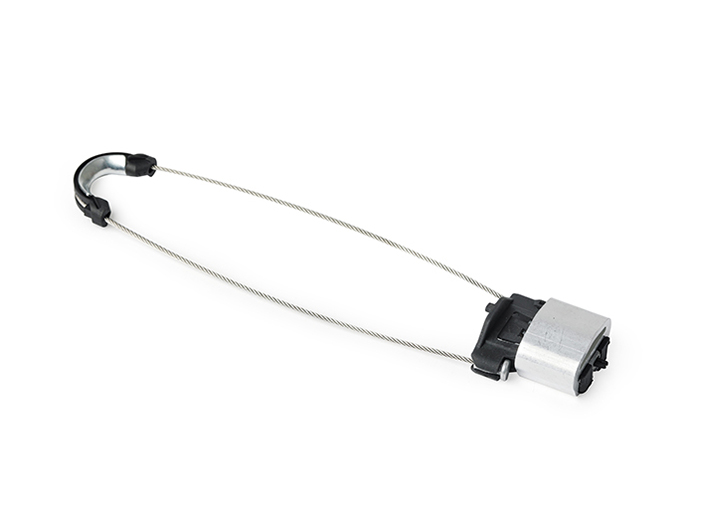
Definition of a Dead End Clamp
A dead end clamp (also known as a tension clamp) is a mechanical fitting used to secure and anchor overhead conductors or cables at terminal points, such as poles, towers, or end spans. Its primary function is to withstand tensile forces and transfer the mechanical load of the conductor to the supporting structure.
Dead end clamps are widely used in:
Overhead power transmission lines
Distribution networks
ADSS and OPGW fiber optic cable installations
Unlike suspension clamps, which support cables vertically, dead end clamps are designed to resist horizontal tension.
Structure of a Dead End Clamp
A typical dead end clamp consists of several key components, each designed to ensure high mechanical strength and secure cable fixation.
Clamp Body
The clamp body is usually made of high-strength aluminum alloy or galvanized steel. It provides the main load-bearing structure and distributes tensile forces evenly across the conductor.
Wedge or Gripping Mechanism
Many dead end clamps use a wedge-shaped or preformed grip design. This structure tightly grips the conductor when tension is applied, preventing slippage without damaging the cable.
U-Bolt or Anchor Shackle
This component connects the clamp to insulators, poles, or tower hardware, allowing secure installation and effective load transfer.
Protective Inserts (Optional)
For fiber optic cables or insulated conductors, protective inserts may be included to prevent surface damage and improve long-term reliability.
Working Principle of a Dead End Clamp
The working principle of a dead end clamp is based on mechanical friction and tensile force transfer.
When the conductor or cable is inserted into the clamp and tension is applied:
The gripping mechanism tightens around the conductor.
Tensile force increases the friction between the clamp and the cable.
The load is transferred from the conductor to the clamp body.
The clamp transmits the force to the pole, tower, or insulator string.
As tension increases, the gripping force automatically increases, ensuring self-locking performance and preventing conductor slippage.
Key Functions and Advantages
Dead end clamps offer several important advantages in overhead line installations:
High tensile strength to withstand long-span loads
Secure anchoring at terminal and angle points
Excellent corrosion resistance for outdoor environments
Quick and reliable installation
Compatibility with various conductor and cable types
These features make dead end clamps essential components in both power and communication infrastructure.
Typical Applications
Dead end clamps are commonly used in:
End points of overhead transmission lines
Angle towers where direction changes
Long-span river crossings
ADSS and OPGW fiber optic cable tensioning
Distribution line anchoring
Their ability to maintain mechanical stability under continuous load ensures long-term system reliability.
Dead End Clamp vs Suspension Clamp
| Feature | Dead End Clamp | Suspension Clamp |
| Main Function | Anchoring & tensioning | Supporting & hanging |
| Load Direction | Horizontal tensile load | Vertical load |
| Installation Position | Line ends, angle points | Straight-line spans |
| Mechanical Strength | Very high | Medium |
Understanding this difference helps engineers select the correct fitting for each application.
Conclusion
A dead end clamp plays a vital role in overhead line systems by securely anchoring conductors and transferring tensile forces to supporting structures. With a robust structure and a self-locking working principle, dead end clamps ensure safety, durability, and long-term performance in both power transmission and fiber optic networks.
Choosing the right dead end clamp—based on conductor type, load requirements, and environmental conditions—is essential for reliable infrastructure operation.
FAQ
1. What is the main purpose of a dead end clamp?
The main purpose of a dead end clamp is to anchor and terminate overhead conductors or cables, transferring tensile loads from the line to poles, towers, or other supporting structures. It ensures mechanical stability at line ends, angle points, and long-span sections.
2. Is a dead end clamp the same as a tension clamp?
In most applications, dead end clamps and tension clamps refer to the same type of fitting. Both are designed to withstand tensile forces and securely fix conductors. However, the term “dead end clamp” is more commonly used for terminal anchoring points.
3. Where should a dead end clamp be installed?
Dead end clamps are typically installed at:
End points of overhead lines
Angle towers or poles
Long-span crossings (rivers, valleys)
Fiber optic cable termination points (ADSS, OPGW)
4. Can dead end clamps be used for fiber optic cables?
Yes. Specially designed dead end clamps are widely used for ADSS and OPGW fiber optic cables. These clamps often include protective inserts to prevent damage to the cable sheath while maintaining high tensile strength.
5. What materials are commonly used for dead end clamps?
Dead end clamps are usually made from:
Aluminum alloy – lightweight, corrosion-resistant
Galvanized steel – high strength, suitable for heavy loads
Material selection depends on conductor type, load requirements, and environmental conditions.
6. How do I choose the right dead end clamp?
When selecting a dead end clamp, consider:
Conductor or cable diameter
Rated tensile strength
Installation environment (coastal, industrial, high humidity)
Applicable standards (IEC, ASTM, GB, etc.)
Correct matching ensures safety and long service life.
7. Are dead end clamps reusable?
In general, dead end clamps are not recommended for reuse, especially after long-term service or high-load operation. Reusing clamps may compromise mechanical performance and line safety.
8. What is the difference between a dead end clamp and a suspension clamp?
Dead end clamp: Anchors and tensions the line, bears horizontal loads
Suspension clamp: Supports the line vertically in straight spans
They serve different mechanical purposes and are not interchangeable.