
Why Cable Accessory Standards Matter
Cable accessories—compression connectors, cable lugs, insulation-piercing connectors (IPC), and aerial-cable anchoring fittings—are the silent weak points of any power network. A substation can have perfect transformers andswitchgear, yet a single under-specified lug can overheat, loosen, and take down a whole feeder. That is exactly why IEC 61238 cable accessories standards, together with NFC 33042, matter so much to procurement and engineering teams.
Standards exist so that a connector bought in 2026 performs identically to one bought in 2030, and so that an accessory from one supplier is electrically and mechanically interchangeable with another. For global utilities and EPCs, two standards dominate the specification sheet: IEC 61238 for compression and mechanical connectors, and NFC 33042 (the French NF C 33-042:2013) for low-voltage aerial insulated-cable anchoring devices.
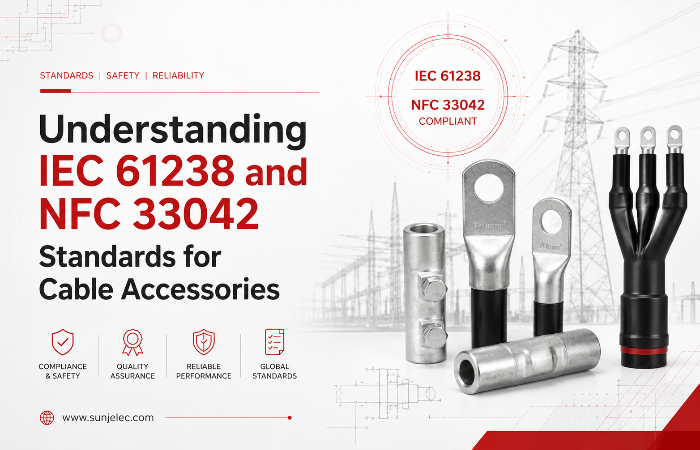
Understanding IEC 61238 and NFC 33042 Standards for Cable Accessories
What Is IEC 61238? (Connectors & Lugs)
IEC 61238 defines the type-test methods and requirements for compression and mechanical connectors for power cables—terminal lugs, through-connectors, and insulation-piercing connectors. It confirms that a connector can carry its rated current without excessive temperature rise, survive short circuits, and remain mechanically sound over its service life.
The original IEC 61238-1:2003 covered power cables up to 30 kV (Um = 36 kV). In 2018 the standard was restructured into three parts to better separate voltage classes and connector technologies, while keeping the same underlying test philosophy.
The IEC 61238-1 Family at a Glance
| Standard Part | Voltage Range | Conductor Scope | Covers |
|---|---|---|---|
| IEC 61238-1-1:2018 | ≤ 1 kV (Um = 1.2 kV) | Cu 2.5–1200 mm² / Al 16–1200 mm² | Compression & mechanical connectors on non-insulated conductors |
| IEC 61238-1-2:2018 | ≤ 1 kV (Um = 1.2 kV) | Cu 2.5–300 mm² / Al 16–500 mm² | Insulation-piercing connectors (IPC) on insulated conductors |
| IEC 61238-1-3:2018 | > 1 kV up to 30 kV (Um = 36 kV) | Cu & Al medium-voltage connectors | MV compression/mechanical connectors (the 30 kV scope of the 2003 edition) |
All three parts exclude overhead-line conductors and sliding contacts, and they reference IEC 60228 for conductor classes. SUNJ’s Cable Lugs and Connectors are built to these international test and material requirements.
Class A vs Class B Connectors
IEC 61238 splits connectors into mechanical service classes that determine how rigorously they are tested:
- Class A — for networks that can experience high-intensity, long-duration short circuits. These connectors undergo heat-cycle, short-circuit and mechanical tests, making them suitable for the majority of utility and industrial applications.
- Class B — for networks where overloads or short circuits are cleared rapidly by protective devices (e.g. fast-acting fuses). They require heat-cycle testing only.
Buyer tip: For exposed distribution and sub-transmission networks, specify Class A. Reserve Class B for controlled environments with proven fast fault clearing.
How IEC 61238 Cable Accessories Standards Are Tested
Class A connectors must pass three hallmark type tests. Understanding them helps you read a supplier’s test report with confidence:
- Heat-cycle test — a total of 1,000 cycles. The first cycle raises the reference conductor to 120°C at equilibrium; the median connector must reach at least 100°C. Measurements are taken at cycles 0, 200 (before/after short circuit), 250, then every 75 cycles.
- Short-circuit test — six short-circuits applied after the 200th heat cycle, raising bare reference conductors from ~35°C to between 250°C and 270°C. (Class A only.)
- Mechanical test — a tensile pull with conductor lengths ≥ 500 mm between connector and jaws, load applied at ≤ 10 N/mm² per second up to the copper limit (60 × A in mm², max 20,000 N), held for 1 minute.
What Is NFC 33042 (NF C 33-042)?
NFC 33042 is the shorthand many manufacturers—including SUNJ—use for the French national standard NF C 33-042. Its current edition is NF C 33-042:2013 (published September 2013), titled “Insulated cables and their accessories for power systems — Anchoring devices for overhead and overhead-underground services with insulated cables, of rated voltage 0.6/1 kV.” In plain terms, it specifies the low-voltage (0.6/1 kV) anchoring and support fittings used on aerial insulated (ABC) cable networks—dead-ends, anchors and clamps for overhead and overhead-to-underground service connections.
It is widely mandated in French-speaking markets—France, the Maghreb, and large parts of West and Central Africa and the Middle East—where utilities expect the French national acceptance in tender documents. NF C 33-042 belongs to the broader French NF C 33 family for aerial bundled cable (ABC) accessories (NF C 33-040 suspension, NF C 33-041 anchoring, NF C 33-045 test requirements), and aligns with the European EN 50483 series for LV aerial bundled cable accessories.
NF C 33-042 vs IEC 60502-4 and EN 50483
These are different voltage classes and product types. IEC 60502-4 is the international standard for accessories (joints/terminations) of extruded-insulation cables and sits at medium/high voltage. NF C 33-042 is a French low-voltage standard for aerial insulated-cable anchoring devices, whose European counterpart is the EN 50483 series. Specifying NFC 33042 is therefore a French-market compliance gate for ABC fittings—not a substitute for IEC 61238 (connectors) or IEC 60502-4 (MV/HV joints).
IEC 61238 vs NFC 33042: Complementary, Not Competing
A common mistake is treating them as alternatives. They cover different product families within the same network:
| Dimension | IEC 61238 | NFC 33042 (NF C 33-042) |
|---|---|---|
| Product type | Connectors, lugs, IPC | LV aerial insulated-cable anchoring devices (ABC fittings) |
| Voltage | ≤ 30 kV (split by part) | 0.6/1 kV (LV) |
| Core focus | Compression / mechanical connection | Anchoring / support fittings for aerial insulated cables |
| Primary market | Global / IEC member states | French & francophone utilities |
| Companion standard | IEC 61284 (overhead-line fittings) | EN 50483 (LV ABC accessory tests); NF C 33-040/041/045 family |
Buyer's Compliance Checklist
Before you release a purchase order, verify the following against your specification:
- Valid certificate — confirm IEC 61238 (and NFC 33042 where the market requires it), issued by an accredited body.
- Voltage class / Um — match the part (e.g. IEC 61238-1-1 for ≤1 kV, -1-3 for up to 30 kV; NF C 33-042 applies to 0.6/1 kV LV aerial insulated-cable fittings).
- Conductor material & size — confirm the Cu/Al cross-section range covers your cable (e.g. 2.5–1200 mm²).
- Class A vs B — specify Class A for exposed or fault-prone networks.
- Type-test report — ask for the heat-cycle, short-circuit and mechanical results, not just a logo on the catalogue.
- Raw-material standard — verify copper purity and plating (e.g. electro-tin-plated high-conductivity copper) and IEC 60228 conductor compatibility.
SUNJ's Cable Accessories & Standard Compliance
Crucially, SUNJ products are certified to IEC 61238, IEC 61284 and NFC 33042 (NF C 33-042:2013), backed by ISO 9001 (quality) and ISO 14001 (environment) management systems. An overseas warehouse in Turkey shortens lead times and localizes service for European, African and Middle Eastern projects.
Need proof for your tender? Request SUNJ’s IEC 61238 / NFC 33042 type-test reports and certificates for your specific voltage class and conductor size.
Frequently Asked Questions
What is IEC 61238?
IEC 61238 defines the type-test methods and requirements for compression and mechanical connectors used on power cables—terminal lugs, through-connectors and insulation-piercing connectors. It ensures a connector carries rated current, survives short circuits, and stays mechanically sound over its service life.
What is the difference between IEC 61238-1-1, -1-2 and -1-3?
The 2018 revision split the old IEC 61238-1:2003 into three parts by voltage and conductor type: -1-1 covers ≤1 kV non-insulated conductors, -1-2 covers ≤1 kV insulation-piercing connectors, and -1-3 covers >1 kV up to 30 kV (Um = 36 kV) MV connectors.
What does NFC 33042 (NF C 33-042) actually cover?
NFC 33042 is the manufacturer shorthand for the French standard NF C 33-042:2013. It specifies the low-voltage (0.6/1 kV) anchoring and support fittings for aerial insulated (ABC) cables—dead-ends, anchors and clamps used in overhead and overhead-to-underground service connections, not MV joints or terminations.
Is NFC 33042 the same as IEC 60502-4?
No. IEC 60502-4 covers medium/high-voltage extruded-insulation cable accessories (joints/terminations), while NFC 33042 (NF C 33-042:2013) is a French low-voltage standard for aerial insulated-cable anchoring devices. Its European counterpart is the EN 50483 series for LV aerial bundled cable accessories.
What is Class A versus Class B in IEC 61238?
Class A connectors face networks with high-intensity, long-duration short circuits and must pass heat-cycle, short-circuit and mechanical tests—suitable for most applications. Class B connectors are for networks where protective devices clear faults fast (e.g. fuses) and need only heat-cycle testing.
What type tests does IEC 61238 require?
Class A connectors undergo three: a 1,000-cycle heat-cycle test, six short-circuit applications after the 200th cycle, and a tensile mechanical test. Class B skips the short-circuit test. Test reports should show cycle counts, temperatures and currents achieved.
Are IEC 61238 and NFC 33042 interchangeable?
No. IEC 61238 governs compression and mechanical connectors (lugs, IPC); NFC 33042 (NF C 33-042) governs low-voltage aerial insulated-cable anchoring fittings. They cover different product families, so a full cable-accessory specification often needs both—plus IEC 61284 for overhead-line fittings.
Do SUNJ cable lugs and connectors comply with IEC 61238?
Yes. SUNJ’s Cable Lugs and Connectors are produced to international raw-material and test standards, and the company’s product range is certified to IEC 61238, IEC 61284 and NFC 33042. Request the type-test report and certificate for your voltage class. View cable lugs & connectors →
What voltage classes do these standards cover?
IEC 61238 spans low voltage up to 30 kV (Um = 36 kV) across its three parts; NF C 33-042 (NFC 33042) applies to 0.6/1 kV low-voltage aerial insulated-cable fittings. Together they address LV/MV connectors and LV ABC anchoring accessories used across distribution networks.
How do I choose a compliant cable-accessory supplier?
Verify valid certificates (IEC 61238, IEC 61284, NFC 33042 where required), match voltage/Um and conductor size, confirm Class A rating for harsh networks, and review type-test reports. Explore SUNJ cable accessories →
Conclusion
Standards turn “it looks right” into “it is proven.” IEC 61238 gives you confidence in every connector and lug up to 30 kV; NFC 33042 (NF C 33-042:2013) gives you confidence in the low-voltage aerial insulated-cable anchoring fittings that keep ABC networks securely connected. Specify both, verify the test reports, and your network’s weakest links become its most dependable ones.
Conclusion
Standards turn “it looks right” into “it is proven.” IEC 61238 gives you confidence in every connector and lug up to 30 kV; NFC 33042 (NF C 33-042:2013) gives you confidence in the low-voltage aerial insulated-cable anchoring fittings that keep ABC networks securely connected. Specify both, verify the test reports, and your network’s weakest links become its most dependable ones.
Related Resources
Related Resources
- SUNJ Cable Lugs and Connectors
- SUNJ Cable Accessories
- SUNJ Aerial Cable Accessories
- SUNJ High-Voltage Products
- Polymer vs Porcelain Insulators
- Fuse Cutouts for Transformer Protection
Specify Compliant Cable Accessories With Confidence
Get IEC 61238, IEC 61284 and NFC 33042 certified lugs, connectors and MV accessories—backed by SUNJ’s 20-year expertise and Turkey warehouse.
Disclaimer: This article is for general guidance. Always reference the latest official IEC and NF C publications and your local utility specifications before procurement. SUNJ product certifications are listed per the company’s published quality documentation.