
Introduction
Buyers often ask whether copper lugs are “better” than aluminum lugs. For B2B projects, that question is incomplete. A reliable decision separates three layers: (1) bulk material conductivity, (2) finished joint performance after correct preparation and crimping, and (3) copper–aluminum compatibility when the cable metal and the equipment terminal metal are different.
SUNJ Electric publishes clear product families for this comparison: AU aluminium crimp lugs (DIN) for aluminum cable to aluminum equipment ends, AUS copper crimp lugs for copper cable to copper equipment ends, and DTL-2 Cu-Al bimetal lugs for aluminum (or aluminum alloy) cable transitioning to a copper equipment end. Category overviews for aluminum lugs, copper lugs, and bimetal lugs help buyers browse the wider range.
This guide stays on conductivity and cost for terminal lugs. It does not claim that copper is always better. It shows how to compare equivalent connections, read compatibility markings, and estimate total installed cost before you lock a bill of materials.
Need a Cu / Al / bimetal recommendation?
Send cable metal, equipment terminal metal, conductor size/class, voltage class, and quantity. Contact SUNJ Electric and we will map AU, AUS, or DTL-2 options against your drawings.
Separate Three Layers Before You Compare Price
Material data sheets describe bulk metal. A completed lug joint also depends on geometry, surface condition, crimping method, and how the palm meets the busbar or stud. Compatibility is a third layer: joining aluminum cable directly to a copper bar without a designed transition can create galvanic and contact-resistance risks that neither “cheaper aluminum” nor “better copper” slogans solve.
| Layer | What it measures | What it does not prove |
|---|---|---|
| 1. Bulk material conductivity | Relative ability of copper vs aluminum metal to carry current in the solid body | That any specific lug size or brand will meet your joint temperature rise without checking the finished connection |
| 2. Finished joint performance | Contact resistance, mechanical retention, and thermal behavior after correct strip length, die/hex, and inspection | That material alone guarantees performance if preparation or tooling is wrong |
| 3. Cu–Al compatibility / transition | Whether cable metal and equipment terminal metal match, or a bimetal transition is required | That a same-metal lug can replace a transition lug when metals differ |
Layer 1 — Bulk conductivity (useful, not decisive alone)
Copper has higher electrical conductivity than aluminum on an equal cross-section basis. Aluminum compensates in many power systems by using a larger conductor cross-section and a lug barrel matched to that cable. Category guidance on SUNJ’s aluminum lugs pages notes that aluminum conductivity is lower than copper but still suitable for many electrical connections when the design is correct.
Use Layer 1 to understand why aluminum cable systems often need larger geometry. Do not stop at Layer 1 when awarding a purchase order.
Layer 2 — Finished joint performance
Both AU aluminum lugs and AUS copper lugs are crimp-type terminals with barrel markings for correct crimping location and DIN-standard die alignment on the published product pages. Joint quality therefore depends on following the correct strip length, die set, number of crimps, and inspection—not on the metal name alone.
A poorly prepared copper joint can underperform a correctly prepared aluminum joint of equivalent design duty. Compare equivalent finished connections: matched conductor metal, matched palm interface, and documented tooling.
Layer 3 — Compatibility and transition
When aluminum or aluminum-alloy cable must land on a copper equipment end, SUNJ’s DTL-2 bimetal lug is published for that transition in low voltage: aluminum barrel side for the cable, copper palm side for the copper equipment terminal. The bimetal lugs category also states friction-welding technology and an aluminum barrel with solid copper palm as the technical approach for connecting aluminum conductors to a copper bar.
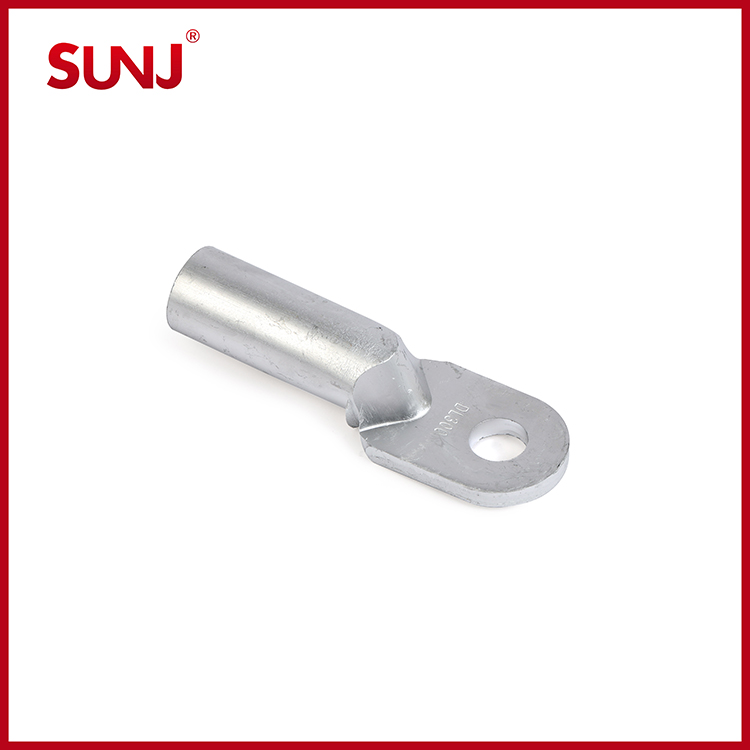
DL Aluminium Crimp Lugs details
Do not treat a pure aluminum lug or a pure copper lug as a silent substitute for a published bimetal transition when the metals differ. Confirm the exact series, cross-section, and palm hole pattern on the model drawing before procurement.
Map SUNJ Product Families: AU, AUS, and DTL-2
Keep the comparison tied to published product-page scope. The table below summarizes what the current SUNJ pages state. Always re-check the live drawing and datasheet for the exact part number you will buy.
| Series | Metal role | Published application scope (product page) | Typical buyer use |
|---|---|---|---|
| AU | Aluminum lug | Transition connection of aluminum or aluminum-alloy cable with the aluminum end of electrical equipment in low voltage; DIN crimp die markings on barrel | Al cable → Al equipment / Al bus interface |
| AUS | Copper lug | Connection of copper cable with the copper end of electrical equipment in medium voltage; DIN crimp die markings on barrel | Cu cable → Cu equipment interface |
| DTL-2 | Cu-Al bimetal lug | Transition connection of aluminum or aluminum-alloy cable with the copper end of electrical equipment in low voltage | Al cable → Cu equipment / Cu bus interface |
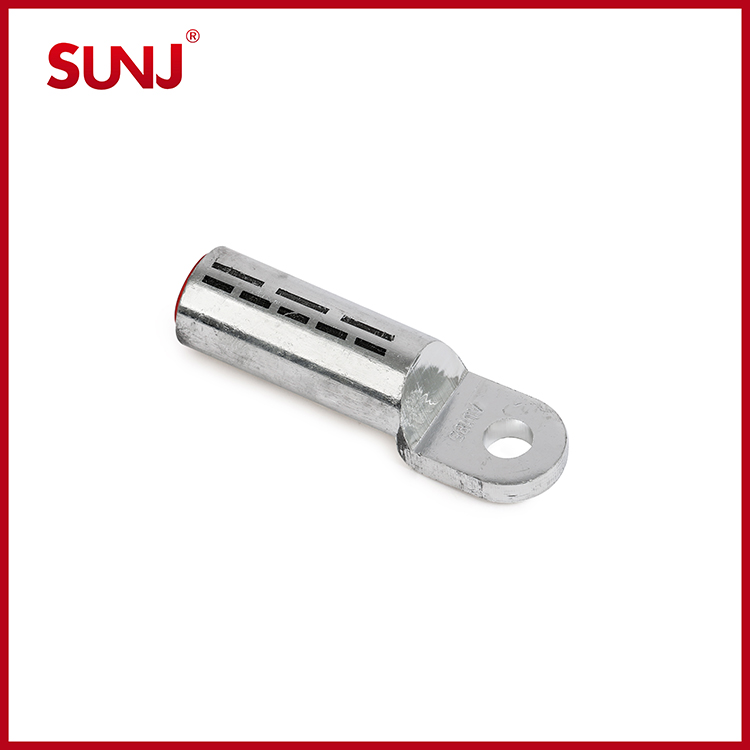
AU Aluminium Crimp Lug To Din details
Browse wider catalogs via aluminum lugs, copper lugs, and bimetal lugs when you need adjacent series (for example other DTL variants). Product conclusions in RFQs should still cite the exact model drawing—not only the category page.
Request AU / AUS / DTL-2 drawings
List conductor metal + size, equipment terminal metal, palm hole requirement, and voltage class. Contact SUNJ Electric for matching datasheets before you finalize the BOM.
Equivalent Connection vs Unit Price
Unit price per lug is a weak KPI. Aluminum piece price is often lower, but the cable size, lug size, tooling, compound, inspection time, and any required transition hardware change the total installed cost.
Build an equivalent-connection comparison
- Fix the duty: continuous current, short-circuit expectation, ambient, and enclosure.
- Fix the metals: cable metal and equipment terminal metal must be explicit.
- Select candidate lugs only inside published scope (AU / AUS / DTL-2 or documented alternatives).
- Include tooling: DIN die availability, calibrated crimp process, and inspection criteria.
- Add labor and rework risk: wrong-metal joints and undocumented field fixes are expensive.
- Only then compare landed cost per equivalent connection—not per piece.
| Cost element | Copper path (e.g. AUS) | Aluminum path (e.g. AU) | Transition path (e.g. DTL-2) |
|---|---|---|---|
| Lug unit price | Often higher per piece | Often lower per piece | Usually between / application-specific |
| Cable / geometry | May allow smaller Cu cable in some designs | Often larger Al cable + matching barrel | Al cable + Cu palm interface |
| Tooling & dies | DIN copper die set | DIN aluminum die set | Die set per aluminum barrel + install checks |
| Compatibility risk | Low if Cu–Cu | Low if Al–Al | Designed for Al cable → Cu equipment |
| Rework / failure exposure | Driven by process quality | Driven by process quality + oxide control | Driven by correct bimetal selection & prep |
If a quote only lists “aluminum cheaper,” ask for the equivalent-connection worksheet. If a quote only lists “copper better,” ask which layer is being claimed—bulk conductivity, finished joint evidence, or compatibility—and request the matching drawing.
Practical Decision Table for Specifiers
| Cable metal | Equipment terminal metal | Start with | Why (based on published scope) | Confirm before PO |
|---|---|---|---|---|
| Aluminum / Al alloy | Aluminum | AU | Published for Al/Al-alloy cable to aluminum equipment end (LV) | Exact size, palm hole, DIN die, LV scope |
| Copper | Copper | AUS | Published for copper cable to copper equipment end (MV page scope) | Exact size, palm hole, DIN die, voltage scope |
| Aluminum / Al alloy | Copper | DTL-2 | Published for Al/Al-alloy cable to copper equipment end (LV) | Exact size, palm pattern, weld/transition evidence on drawing |
| Copper | Aluminum | Do not assume reverse use of DTL-2 | Published DTL-2 scope is Al cable → Cu equipment, not the reverse | Ask for an approved transition design or alternate documented product |
| Mixed / unclear | Unclear | Stop and clarify metals | Layers 1–3 cannot be closed without metal identity | RFQ must state both metals + drawing references |
Markings such as AL/CU on some connector families indicate tested dual-metal conductor acceptance for that specific product. Do not transfer an AL/CU marking from one product family to AU, AUS, or DTL-2 without reading the exact datasheet. For AU/AUS/DTL-2, follow the published same-metal or bimetal scopes above.
Validate your decision table with SUNJ
Attach the cable schedule and equipment terminal photos or drawings. Contact SUNJ Electric to confirm AU, AUS, or DTL-2 before manufacturing release.
FAQ
Is copper always better than aluminum for terminal lugs?
No. Copper has higher bulk conductivity, but the correct choice depends on cable metal, equipment terminal metal, finished joint process, and total installed cost. An equivalent, correctly installed aluminum connection can be the right engineering answer for aluminum cable systems.
When should I use a bimetal lug instead of a copper or aluminum lug?
When aluminum or aluminum-alloy cable must connect to a copper equipment end, use a published transition product such as DTL-2. Do not improvise aluminum-to-copper joints with same-metal lugs.
Do AU and AUS use the same crimping approach?
Both product pages describe barrel markings for correct crimping location with DIN-standard dies. Die sets, strip lengths, and inspection criteria still follow the specific metal and size—confirm on the drawing for the part you order.
Can I select only by conductivity percentage?
No. Conductivity is Layer 1. Specifiers also need Layer 2 (finished joint) and Layer 3 (compatibility). Price comparisons should use equivalent connections.
Where do I browse the full ranges?
Start from aluminum lugs, copper lugs, and bimetal lugs, then open the exact series pages for AU, AUS, and DTL-2.
Conclusion
Copper vs aluminum lugs is not a slogan contest. Separate bulk conductivity, finished joint performance, and Cu–Al compatibility. Map aluminum cable to aluminum equipment with AU-class products, copper-to-copper with AUS-class products, and aluminum-to-copper transitions with DTL-2-class bimetal lugs—always confirmed on the exact model drawing.
Compare total installed cost on equivalent connections. Then lock the BOM with datasheets, not assumptions.
Related Resources
Useful pages already published on sunjelec.com:
- Mechanical Lugs vs Mechanical Cable Connectors: BLMT and BSMB Compared — termination vs intermediate connector roles
- What Are Shear Bolt Cable Lugs? — bolted alternative context for mechanical lugs
- A Reliable Cable Joint Starts Before the Connector Is Installed — preparation discipline before any lug choice
- The Field Fix Fits. But Is It Engineered? — why improvised lug fixes create hidden risk