
Introduction
BLMT mechanical lugs connect cables to equipment terminals. BSMB mechanical cable connectors join cable sections in an intermediate connection. For buyers comparing the two, the first decision is the connection task—not which product has the larger cable range or more bolts.
This guide compares SUNJ ELECTRIC’s published BLMT and BSMB product specifications to help procurement teams, engineers and distributors prepare a clearer technical enquiry. Both appear within the mechanical lugs product range, but their stated applications are different.
Quick answer: Start with BLMT when evaluating a cable-to-equipment termination. Start with BSMB when evaluating a cable-to-cable intermediate connection. Then confirm the conductor details, equipment or joint interface, dimensions and installation requirements for the selected model.
What Is the Difference Between Mechanical Lugs and Mechanical Cable Connectors?
In this comparison, a mechanical lug provides the connection between a cable conductor and an equipment terminal through a connection palm. A mechanical cable connector provides an intermediate connection between cable conductors.
The clamping principle may be similar: both SUNJ series use torque-controlled shear-head bolts. However, a shared fastening method does not make their connection interfaces interchangeable.
| Comparison point | BLMT mechanical torque lugs | BSMB mechanical cable connectors |
|---|---|---|
| Stated application | Cable connection to an aluminum equipment terminal in medium-voltage applications | Intermediate cable connection in medium-voltage applications |
| Listed conductor materials | Copper, aluminum and aluminum alloy | Copper, aluminum and aluminum alloy |
| Body and finish | High-strength aluminum alloy; tin-plated surface | High-strength aluminum alloy; tin-plated surface |
| Distinctive structural feature | Solid connection palm with listed mounting-hole options | Center block |
| Published model ranges | 25–95, 35–150, 95–240 and 120–300 mm² | 25–95, 35–150, 95–240 and 120–300 mm² |
| Installation tool stated on product page | Socket spanner or wrench; no crimping tool required | Socket spanner or wrench; no crimping tool required |
The conductor materials listed above describe the product pages’ stated scope. They do not establish approval for every conductor construction, mixed-material pairing or unequal-size cable combination. Confirm the actual configuration before ordering.
When Should You Consider BLMT Mechanical Lugs?
The BLMT mechanical torque lugs page specifies connections between copper, aluminum or aluminum-alloy cables and the aluminum end of electrical equipment in medium-voltage applications.
BLMT is therefore the relevant starting point when the project requires a cable termination at an equipment connection. Its palm and mounting-hole options are central to that decision.
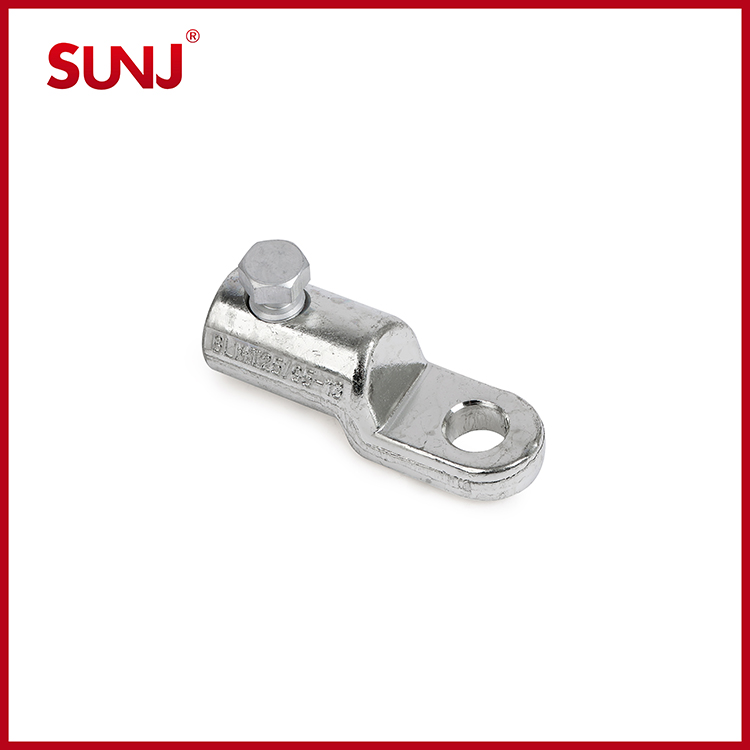
BLMT-25/95 Mechanical Torque Lugs details
Match the equipment interface as well as the cable
The BLMT table lists mounting-hole options of φ13 and φ17 for all four published models, with φ21 additionally listed for BLMT-95/240. These are listed options, not a statement that every lug contains multiple mounting holes.
A cable that falls within the stated conductor range is only one part of the specification. Buyers should also provide the equipment connection drawing and confirm the required palm interface, mounting-hole option and available installation space.
Understand what the solid palm feature means
SUNJ lists a solid palm as a BLMT feature associated with preventing moisture ingress through that part of the lug. This feature should not be treated as a waterproof rating for an entire cable termination. The surrounding insulation and sealing arrangement still require project-specific confirmation.
When Should You Consider BSMB Mechanical Cable Connectors?
The BSMB mechanical cable connector page specifies intermediate connections for copper, aluminum and aluminum-alloy cables in medium-voltage applications.
BSMB is the relevant starting point when two cable sections need to be joined rather than terminated at an equipment connection. The product page lists a center block, a prefilled jointing compound and torque-controlled shear-head bolts.
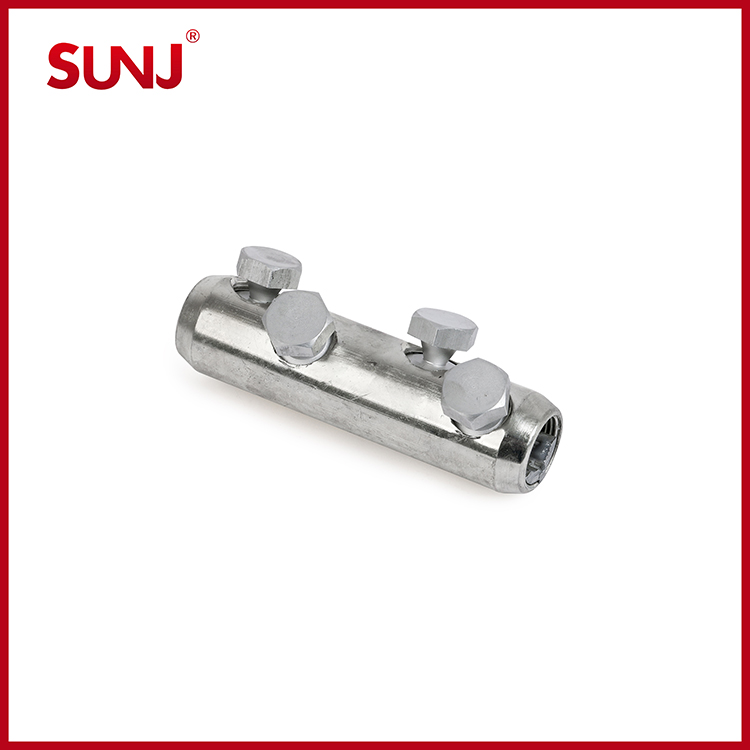
BSMB-95/240 Mechanical Cable Connector details
For a BSMB enquiry, identify both cable ends separately. Provide the material, cross-section, conductor construction and relevant cable data for each side. Do not assume that a wide published cable range automatically approves every possible combination within that range.
BLMT vs BSMB: Why Matching Cable Ranges Can Be Misleading
Both series use the same four published conductor-range labels. Nevertheless, their dimensions and bolt counts differ because they serve different connection tasks.
| Cable range | BLMT model | BLMT L / bolts | BSMB model | BSMB L / bolts |
|---|---|---|---|---|
| 25–95 mm² | BLMT-25/95 | 73 / 1 | BSMB-25/95 | 66 / 2 |
| 35–150 mm² | BLMT-35/150 | 100 / 1 | BSMB-35/150 | 110 / 2 |
| 95–240 mm² | BLMT-95/240 | 129 / 2 | BSMB-95/240 | 125 / 4 |
| 120–300 mm² | BLMT-120/300 | 133 / 2 | BSMB-120/300 | 139 / 4 |
L values reproduce the published product tables. Confirm dimensions, units, tolerances and drawing revisions with SUNJ ELECTRIC before design approval. Bolt counts are model data, not a ranking of connection quality.
For example, the 25–95 mm² models share a cable-range label but have different published lengths and bolt counts. Neither those numbers nor the shared range makes a BSMB connector a substitute for a BLMT equipment lug.
Ranges also overlap within each series. A 95 mm² conductor appears within three published model ranges. That overlap is a reason to verify the complete application—not an automatic instruction to select the smallest listed model.
A Three-Step Buyer’s Check Before Requesting a Quote
Step 1: Identify the connection
- Cable to equipment terminal: evaluate BLMT.
- Cable to cable intermediate connection: evaluate BSMB.
Step 2: Gather the interface details
- For BLMT: equipment terminal drawing, terminal material, mounting-hole requirement and available space.
- For BSMB: cable information for both sides and the intended cable-joint arrangement.
Step 3: Confirm the project requirements
- Conductor material, cross-section, shape and stranding details.
- Project voltage and applicable specification.
- Required installation instructions and model-specific supporting documents.
- Quantity, delivery destination and purchasing schedule.
Use this checklist to prepare an enquiry. It is not an automatic product approval or installation procedure.
Installation and Documentation: What Still Needs Confirmation?
Both product pages state that installation uses a socket spanner or wrench rather than a crimping tool. That does not mean installation is tool-free or that the same procedure applies to every model.
Request the applicable instructions for conductor preparation, insertion, bolt tightening and the surrounding cable accessory system. A comparison article cannot replace those instructions.
The individual BLMT and BSMB pages describe medium-voltage applications without stating a specific numerical voltage rating or model-specific test-report scope. Buyers should therefore confirm the required voltage and request supporting documentation for the exact model and application, rather than assuming a general website statement covers every configuration.
Need to Confirm BLMT or BSMB for Your Project?
Send SUNJ ELECTRIC your connection type, cable data and equipment or joint details. Ask for the relevant model drawing, installation information and available supporting documents before placing your order.
For BLMT, include the equipment terminal and mounting-hole requirements. For BSMB, include the cable specifications for both ends.
FAQ
What is the main difference between BLMT and BSMB?
BLMT is specified for connecting a cable to an aluminum equipment terminal. BSMB is specified for an intermediate cable connection. The connection task determines which series to evaluate first.
Do both series list copper and aluminum conductors?
Yes. Both product pages list copper, aluminum and aluminum-alloy cables. Confirm the actual conductor construction and connection configuration with SUNJ ELECTRIC; the material listing alone does not approve every possible combination.
Can I select either product based only on cable cross-section?
No. First identify whether the project needs an equipment termination or an intermediate cable connection. Then confirm the cable details, interface dimensions and project requirements for the model being considered.
Do BLMT and BSMB require a hydraulic crimping tool?
The product pages state that a socket spanner or wrench is used instead of a crimping tool. Follow the model-specific installation instructions and confirm the required tools before site work.
Does a BLMT solid palm make the whole termination waterproof?
No complete-system waterproof rating should be inferred from that feature alone. The solid palm is a product feature; the full termination’s sealing and insulation requirements must be assessed separately.
Conclusion
Choosing between BLMT mechanical lugs and BSMB mechanical cable connectors starts with one question: are you connecting a cable to equipment or joining two cable sections? Once the connection type is clear, confirm the conductor specifications, interface dimensions and installation requirements before selecting a model.
For your next project, share your cable specifications and connection drawings with SUNJ ELECTRIC. Include the equipment terminal and mounting-hole requirements for BLMT, or the cable details for both ends for BSMB, so our team can help review the relevant product options and documentation before you place an order.