
Overview
Metal oxide surge arresters (MOA) protect high-voltage substations by connecting phase-to-ground and acting as a static switch: under normal voltage they pass only microampere leakage, but when lightning or switching surges arrive, the zinc oxide varistors’ resistance collapses and diverts the surge energy safely to ground, clamping the overvoltage below the equipment’s withstand level. This is the basis of insulation coordination—keeping every transient below the breakdown voltage of transformers, breakers, and bushings. Selection centers on continuous operating voltage (Uc), temporary overvoltage (TOV), nominal discharge current (In), and residual voltage (protection level).
Why Substations Need Surge Protection
A high-voltage substation concentrates the most expensive and sensitive equipment on the network—power transformers, circuit breakers, instrument transformers, bushings, and disconnectors. All of it is built to a defined withstand voltage: exceed it, even for microseconds, and the insulation breaks down, triggering costly failures and long outages.
Two sources of overvoltage threaten that insulation. Lightning impulses arrive in the microsecond range via direct strikes or induced surges on incoming lines. Switching impulses occur in the millisecond range when breakers operate or lines re-energize. Without a device to absorb these spikes, substations would need far heavier (and far costlier) insulation everywhere.
Enter the metal oxide surge arrester (MOA)—the international standard for overvoltage protection in MV, HV, and UHV systems. SUNJ supplies arresters and a full range of high-voltage products for exactly these networks.
What Is a Metal Oxide Surge Arrester?
A modern surge arrester is essentially a sealed column—or several parallel columns—of metal oxide varistors (MOVs) housed in porcelain or polymer insulation with metal end terminals. There is no spark gap; the MOV stack itself does all the work. Each MOV is a ceramic block in which zinc oxide makes up roughly 90% of the mass, with oxide additives fine-tuning the electrical behavior.
The arrester is normally connected phase-to-ground. In steady operation it is almost an open circuit; during a surge it briefly becomes a low-resistance path that shunts energy to earth. That dual behavior is why it is often described as a “static switch.”
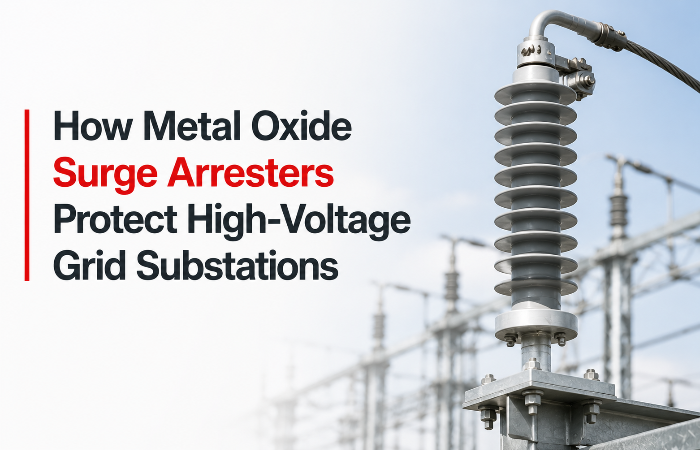
How Metal Oxide Surge Arresters Protect High Voltage Grid Substations
How the ZnO Varistor Clamps Overvoltage
The protection comes from the strongly non-linear voltage–current (V–I) characteristic of zinc oxide. At the system’s continuous operating voltage, the ZnO grains present very high resistance, so only a tiny microampere-level leakage current flows. The arrester sits there, invisible, day after day.
When a surge arrives, the applied voltage rises sharply and the varistor’s resistance collapses. Current surges from tens of amperes up to tens of kiloamperes, and the arrester absorbs and dissipates the excess energy. Crucially, it clamps the residual (peak) voltage to a safe, predictable level—the protection level—so the connected equipment never sees the full surge.
After the surge passes, the varistor returns to its high-resistance state automatically. The whole action is passive, instantaneous, and repeatable across many events—though each event deposits some heat that must dissipate before the next.
In one sentence
Normal voltage → high resistance, near-zero current. Surge voltage → low resistance, current diverted to ground, peak voltage clamped. Surge gone → back to high resistance.
Insulation Coordination in Substations
The real job of an arrester is not just “absorbing surges”—it is achieving insulation coordination. A substation’s equipment is designed to withstand specific voltages for specific durations:
- Continuous operating voltage — the normal steady-state level.
- Temporary overvoltages (TOV) — sustained, second-range overvoltages the arrester must survive, not clip.
- Switching surges — slow-front, millisecond-range transients.
- Lightning impulses — fast-front, microsecond-range transients.
Insulation coordination means choosing arresters whose protection level sits comfortably below the equipment’s withstand voltage, with a safety margin. Done right, every transient stays under the breakdown threshold and the substation keeps running. A correctly rated arrester is also robust enough to withstand TOV without damage.
Types of Substation Arresters
| Type | Characteristics | Best For |
|---|---|---|
| Porcelain insulator | High mechanical strength, weathering resistant, 10–500 kV | Outdoor substations, transmission lines |
| Composite (polymer) | Silicone rubber housing, light, high pollution resistance, anti-explosion | Polluted/coastal sites, compact layouts |
| GIS (metal-enclosed) | Sealed stainless-steel housing, pressure-equalizing shield, 110–220 kV | Gas-insulated switchgear substations |
Key Selection Ratings
When specifying arresters for a substation, these ratings drive the choice:
| Rating | What It Means |
|---|---|
| Continuous operating voltage (Uc) | Maximum steady voltage the arrester can carry continuously without aging |
| Temporary overvoltage (TOV) | Sustained overvoltage the arrester must survive without failure |
| Nominal discharge current (In) | Reference surge current (commonly 5 kA or 10 kA) used to define residual voltage |
| Residual voltage (protection level) | Peak voltage across the arrester at In—must sit below equipment withstand |
| Energy / charge rating (Qrs) | Energy absorption and charge-transfer capability for repeated surges |
Where Arresters Are Installed
In a substation, arresters are placed as close as practical to the equipment they protect—typically at transformer terminals, breaker bushings, and the incoming/outgoing line entrances. Protecting the transformer is a priority because it is the costliest asset and the least tolerant of overvoltage. For overhead networks, arresters are also mounted on poles to shield distribution transformers and line equipment at the source.
SUNJ Surge Arresters for Substations
SUNJ supplies lightning/surge arresters and a complete portfolio of high-voltage products for substation and overhead-network protection. Our arresters are built around reliable zinc-oxide varistor stacks and sealed insulation housings.
- Voltage coverage: distribution through high-voltage classes (10 kV and above).
- Housing options: porcelain and polymer (composite) for different environments.
- Quality systems: ISO 9001 and ISO 14001 certified manufacturing.
- Global logistics: overseas warehouse in Turkey for fast delivery and localized service.
- Application support: we help match Uc, TOV, In, and residual voltage to your substation’s insulation coordination needs.
Frequently Asked Questions
How do metal oxide surge arresters protect a substation?
They connect phase-to-ground and act as a static switch: at normal voltage they pass only microampere leakage, but during a surge the ZnO varistors’ resistance collapses and divert the energy to earth, clamping the overvoltage below equipment withstand. For model advice, request a free quote from SUNJ.
What is inside a metal oxide arrester?
The active element is a stack of zinc oxide varistors (ZnO blocks, ~90% ZnO by mass) housed in a sealed porcelain or polymer insulator with metal end terminals. There is no spark gap—the MOV stack does the clamping.
How does the zinc oxide varistor clamp overvoltage?
ZnO has a strongly non-linear V–I curve. At operating voltage it is highly resistive; under surge voltage its resistance drops sharply, letting large current flow to ground while the peak (residual) voltage stays near the rated protection level.
What is insulation coordination and why does it matter?
It is the practice of keeping every transient overvoltage below the equipment’s dielectric withstand voltage. Correctly rated arresters provide the safety margin that lets transformers and breakers use economical insulation without risking breakdown.
What ratings must I check when selecting a substation arrester?
Check continuous operating voltage (Uc), temporary overvoltage (TOV), nominal discharge current (In), and residual voltage (protection level). The residual voltage must sit below the protected equipment’s withstand, with margin.
Porcelain vs. polymer (composite) surge arresters—which for substations?
Porcelain offers high mechanical strength for standard outdoor substations. Polymer/composite is lighter, anti-explosion, and more pollution-resistant—better for coastal, industrial, or space-constrained layouts.
Where are surge arresters installed in a substation?
As close as practical to the equipment they protect—transformer terminals, breaker bushings, and line entrances. Transformer protection is prioritized because transformers are the costliest, least surge-tolerant asset.
What standards apply to metal oxide surge arresters?
Key references are IEC 60099 series and IEEE C62 series, covering ratings, tests, and application. SUNJ manufactures under ISO 9001 / ISO 14001 quality and environmental systems.
How is arrester condition monitored?
The resistive (third-harmonic) component of leakage current is the main diagnostic—it rises as the varistor ages. Periodic measurement flags degradation before failure, supporting predictive maintenance.
How do I request a quote for SUNJ surge arresters?
Email [email protected] or call +86 18875849654 with system voltage, housing preference, and required ratings. Our engineering team responds within 24 hours.
Conclusion
Metal oxide surge arresters are the quiet guardians of high-voltage substations. By exploiting the non-linear behavior of zinc oxide, they keep normal leakage negligible yet instantly clamp lightning and switching surges to a safe level—making insulation coordination possible and protecting multimillion-dollar equipment from microsecond-scale destruction.
Whether you specify porcelain for a standard yard or polymer for a polluted coastal site, the engineering fundamentals above hold: rate for Uc, TOV, In, and residual voltage, place the arrester close to the asset, and verify against the equipment withstand curve. SUNJ supports buyers with standards-aware arresters and responsive global delivery.
As a manufacturer serving 80+ countries, we help utilities and EPC contractors specify the right surge protection for every substation and overhead network.
Related Resources
- SUNJ High-Voltage Products
- Aerial Cable Accessories
- A Buyer’s Guide to Fuse Cutouts for Distribution Transformer Protection
- Polymer Insulators vs. Porcelain Insulators: The Paradigm Shift in High-Voltage Lines
- About SUNJ Products
Need reliable surge arresters for your substation?
SUNJ supplies metal oxide (ZnO) surge arresters with porcelain and polymer options for HV substations and overhead networks. Get a fast, customized quote from our engineering team.