
Introduction
Cable splice projects often start with a type name—inline, multi-tap, or reducer—before a part number exists. For B2B buyers, type names are a useful taxonomy. Product conclusions, however, must stop at what the exact model drawing and product page actually state.
This article keeps the taxonomy, then anchors documented SUNJ examples: BSMB mechanical cable connectors for intermediate connection of copper, aluminum, or aluminum-alloy cable in medium voltage, and BLMT mechanical torque lugs for cable-to-aluminum-equipment terminations. Multi-tap and reducer designs are explained as connector classes; do not assume BSMB or BLMT automatically cover every multi-tap or reducer configuration unless the specific drawing says so.
Browse the wider mechanical lugs category for shear-bolt terminal families, then return to model-level documents for splice decisions.
Share your splice matrix
Send both-end conductor metals/sizes, number of ports, voltage class, and whether you need an intermediate splice or an equipment lug. Contact SUNJ Electric for drawing-based matching.
Type Taxonomy: Inline, Multi-Tap, Reducer
| Type | Engineering intent | RFQ data you must provide | Evidence rule |
|---|---|---|---|
| Inline splice connector | Join two conductors on a common axis (often like-for-like, sometimes stepped sizes if drawing allows) | Both-end metal, mm², class, voltage, insulation restoration method | Accept only if the model drawing lists both ends |
| Multi-tap connector | Create a common node with multiple ports / branches | Port count, each port’s conductor data, orientation constraints | Do not infer multi-tap capability from an inline product page |
| Reducer connector | Join unequal conductor sizes in one body | Large-end and small-end sizes/metals, length limits, center features | Confirm unequal-size combinations on the exact drawing |

Inline mechanical shear-bolt cable connector prepared for an intermediate cable splice
Documented SUNJ Example: BSMB as Intermediate Inline Connection
The BSMB product page states that BSMB mechanical aluminum connectors are used for intermediate connection of copper cable, aluminum cable, and aluminum-alloy cable in medium voltage. Published features include:
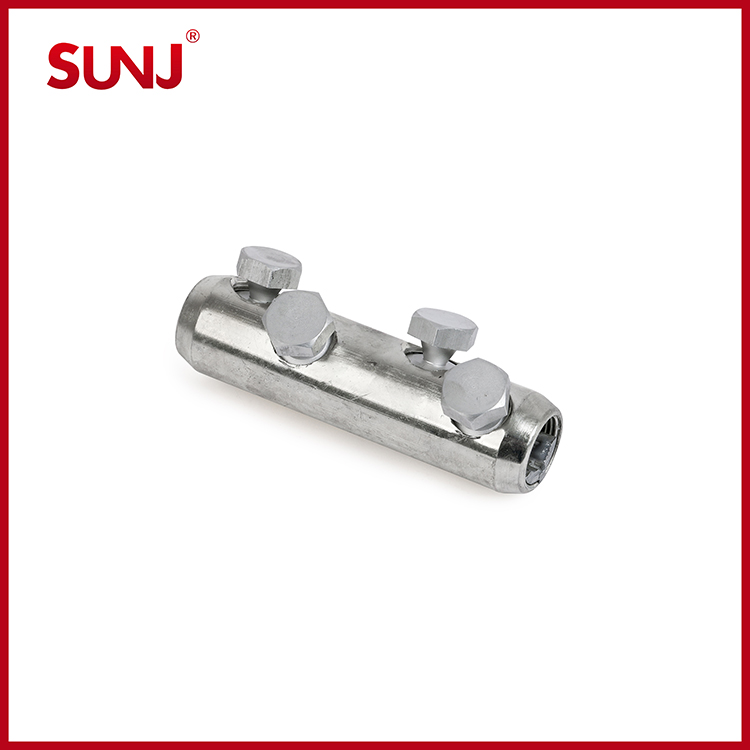
BSMB-95/240 Mechanical Cable Connector details
- Centre with block (center block / center stop feature on the product page).
- No need for crimping tools—only a socket spanner or wrench.
- Torque-controlled shear head bolts intended to protect the conductor and stabilize performance.
- Wide application range (exact mm² combinations still come from the size table/drawing).
- Body of high-strength aluminum alloy; bolts brass or aluminum alloy; tin-plated surface (as published).
That makes BSMB a solid evidence-backed example of an intermediate inline mechanical splice connector with a center block and shear bolts. It does not automatically mean BSMB is a complete multi-tap or reducer catalog. For center-stop installation practice, see also SUNJ’s related guide on shear-bolt central barrier positioning.
Request BSMB size tables
List both conductor ends and voltage class. Contact SUNJ Electric for the matching BSMB drawing and range chart.
Equipment Termination vs Splice: BLMT Boundary
BLMT mechanical torque lugs are published for connection of copper, aluminium, or aluminium-alloy cable with an aluminium end of electrical equipment in medium voltage. Features include torque-controlled sheared-off bolts and a wide application range.
Treat BLMT as a mechanical lug termination family—not as an inline splice body. Mixing “connector” and “lug” language in an RFQ creates wrong drawings and wrong sealing kits.
| Model family | Published role (product page) | Typical graph position | Do not assume |
|---|---|---|---|
| BSMB | Intermediate connection of Cu / Al / Al-alloy cable (MV) | Cable ↔ cable splice | Automatic multi-tap / every reducer combo |
| BLMT | Cable to aluminium equipment end (MV) | Cable ↔ equipment lug | Use as a substitute inline splice without checking drawings |
Multi-Tap and Reducer: Selection Checks Without Over-Claiming
When the design truly needs multi-tap or reducer geometry, collect engineering inputs first. Only then ask whether a documented SUNJ model covers that geometry.
Multi-tap RFQ checklist
- Number of ports and which ports are main vs branch.
- Conductor metal and size for every port (not only the feeder).
- Mechanical orientation and clearance in the joint bay.
- Insulation restoration method for the finished node.
- Explicit drawing confirmation that the model is multi-port—not inferred from an inline photo.
Reducer RFQ checklist
- Large-end and small-end conductor sizes and metals.
- Whether a center stop/block is required for unequal insertion depths.
- Allowed size pairs on the drawing (do not interpolate silently).
- Torque/shear sequence for each side if bolts differ by side on the drawing.
If no published drawing covers the requested multi-tap or reducer combination, the correct next step is an engineering query—not a blog-level assumption.
Have a non-standard port layout?
Attach a sketch of ports and conductor sizes. Contact SUNJ Electric to confirm whether a documented model exists before tender submission.
Selection Matrix Buyers Can Reuse
| Need | First question | Evidence-backed SUNJ starting point | Next verification |
|---|---|---|---|
| Inline intermediate splice | Both ends in published conductor range? | BSMB | Size table + center block use + joint kit |
| Equipment termination lug | Is the equipment end aluminum as scoped? | BLMT | Palm hole / stud details + torque process |
| Multi-tap node | Is multi-port explicitly drawn? | No automatic default SKU from this article | Port-by-port drawing review |
| Reducer unequal sizes | Are both sizes listed as a pair? | Only if drawing lists the pair (ask with BSMB/other series) | Reject silent interpolation |
For category browsing, use mechanical lugs. For splice-vs-lug clarification, see BLMT vs BSMB compared.
FAQ
Is BSMB a multi-tap connector?
The published BSMB page describes intermediate connection with a center block and shear bolts. It does not, by itself, establish a full multi-tap product claim. Confirm ports on the exact drawing.
Can I use BLMT as a cable splice?
BLMT is published as a mechanical lug for cable-to-aluminum-equipment termination. Use splice-rated connectors for intermediate joints unless a drawing explicitly defines another use.
How do I specify a reducer?
Provide both-end sizes and metals, then require the supplier to return a drawing that lists that pair. Do not assume any wide-range body accepts every unequal combination.
What installation tooling does BSMB require per the product page?
The BSMB page states no crimping tools are needed—only a socket spanner or wrench—with torque-controlled shear head bolts. Still follow the model instruction sheet.
Conclusion
Inline, multi-tap, and reducer are useful type labels. Bind purchase decisions to drawings. Use BSMB when you need a documented intermediate mechanical splice with center block and shear bolts; use BLMT when you need a documented equipment-end mechanical lug. For multi-tap and reducer claims, demand port and size-pair evidence before the PO.
Related Resources
Useful pages already published on sunjelec.com:
- Mechanical Lugs vs Mechanical Cable Connectors: BLMT and BSMB Compared — role boundaries
- Shear Bolt Connector Central Barrier and Conductor Positioning Guide — center stop practice
- What Are Shear Bolt Cable Lugs? — shear-bolt lug basics
- A Reliable Cable Joint Starts Before the Connector Is Installed — joint preparation