
Introduction
On LV aerial bundled cable (ABC) projects, dropped washers, nuts, or loose clamp parts create real safety and quality problems at height. That is why buyers look for suspension clamps whose product pages state that no loose parts could fall off during installation.
SUNJ publishes this feature on multiple LV suspension clamp families used with ABC systems, including SPD for four-core self-supporting cables, and SJ94/95/96 plus the 1.1 series (including 1.1B 16-95) for lines with an insulated neutral messenger. Always confirm features against the specific model drawing and installation instruction before procurement or installation.
Start category browsing from suspension clamps. Use dead end clamps when the span needs tension termination rather than suspension support—do not interchange the two roles.

SPD Suspension Clamp ABC Suspension Bridge Cable Clamp
Match clamp family to cable system
Tell us whether the line is four-core self-supporting or neutral-messenger, plus cross-section and angle. Contact SUNJ Electric for SPD / SJ / 1.1 drawing packs.
Two ABC Systems: Do Not Mix Clamp Logic
| System | What the clamp must support | SUNJ families with published fit (check drawing) | Published standards cited on pages |
|---|---|---|---|
| Four-core self-supporting LV aerial cables | The bundled four-core cable assembly on poles/walls; angles per type table | SPD | EN 50483-2 (SPD page) |
| LV aerial cables with insulated neutral messenger | Neutral messenger in the groove / grip device; phase cores remain bundled | SJ94/95/96; 1.1 series (1.1A/1.1B 16-95 on table) | EN 50483-3, NF C 33-040 (SJ & 1.1 pages) |
Selecting an SPD clamp for a neutral-messenger line—or an SJ/1.1 clamp for a four-core self-supporting line—without checking the application sentence is a common RFQ error. Read the application line first.
What “No Loose Parts” Means on SUNJ Product Pages
The phrase appears as a listed feature on the SPD, SJ94/95/96, and 1.1-series pages: “No loose parts could fall off during installation.” Treat it as a published design intent for those families—not as a quantified labor-hour guarantee. This article does not invent installation-time savings percentages.

ABC suspension clamp with retained parts positioned on the cable at the pole
SPD — four-core self-supporting
- Application: installation and suspension of four-core self-supporting LV aerial cables on poles or walls; straight lines and angles up to 90° (per type).
- Feature highlights include corrosion-resistant aluminum alloy body, weather/UV-resistant plastic parts, shear head bolt and wing nut allowing installation without additional tools, and “No loose parts could fall off during installation.”
- Standard listed: EN 50483-2.
- Type table examples on the page: SPD1 / SPD2 / SPD3 with cross-section and angle combinations such as 2-4×(25-50) and 2-4×(25-120) under stated angle limits.
SJ94 / SJ95 / SJ96 — insulated neutral messenger
- Application: hang LV aerial cables on poles with insulated neutral messenger.
- Feature includes “No loose parts could fall off during installation.”
- Standards listed: EN 50483-3, NF C 33-040.
- Type table on the page: SJ94 16-95 (12 kN), SJ95 16-95 (12 kN), SJ96 25-95 (12 kN).
1.1 series — including 1.1B
- Application: hang LV aerial cables on poles with insulated neutral messenger.
- Neutral messenger placed in the groove and locked by an adjustable grip device for different cable sizes.
- Feature includes “No loose parts could fall off during installation.”
- Standards listed: EN 50483-3, NF C33-040.
- Type table on the page includes 1.1A 16-95 and 1.1B 16-95.
Before procurement or installation, confirm these features on the specific model drawing and installation instruction for the exact type you will hang.
Request SPD / SJ / 1.1B drawings
Include system type (self-supporting vs messenger), cross-section, and maximum angle. Contact SUNJ Electric for the matching datasheets.
Why Retained Parts Matter at Height
ABC clamp work is often done from a bucket, ladder, or pole. A part that can fall is a struck-by hazard, a lost-hardware delay, and a quality escape if the crew improvises a replacement. Published no-loose-parts features address that jobsite failure mode. They do not replace training, PPE, or torque/shear procedure.
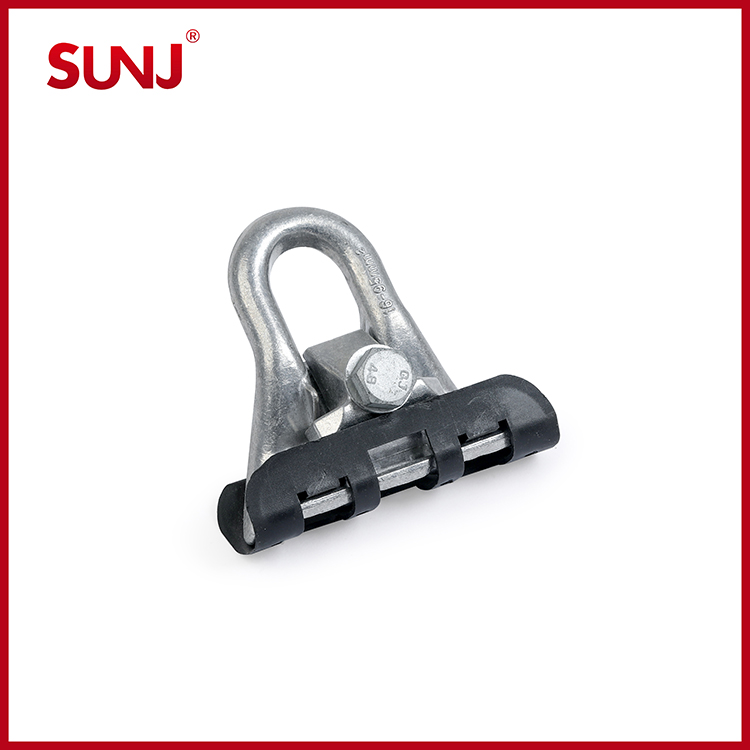
SJ94 series suspension clamps
Field inspection checks (process, not marketing)
- Verify clamp type against the line design (SPD vs SJ/1.1 family).
- Confirm cross-section and angle against the type table on the datasheet.
- Inspect that captivated/retained hardware is present before ascent.
- Follow the model installation instruction for messenger groove or four-core seating.
- After install, check seating, hardware retention, and clearance to pole hardware.
- Record type/batch in the as-built package.
Suspension vs Dead-End Roles
Suspension clamps support the cable on intermediate poles or at limited angles. Dead end clamps terminate tensile load at anchors or angle structures. Using a suspension clamp as a silent dead-end substitute (or the reverse) creates mechanical risk even if both products are high quality.
| Need | Start from | Confirm on drawing |
|---|---|---|
| Intermediate support / limited angle | Suspension clamp category | Angle limit + cable system type |
| Four-core self-supporting suspension | SPD | SPD1/2/3 cross-section & angle pair |
| Neutral-messenger suspension | SJ94/95/96 or 1.1 / 1.1B | Messenger size range + breaking load if listed |
| Tension termination | Dead end clamps | Tension rating + messenger/cable compatibility |
Unsure suspension vs dead-end?
Send the span plan or pole schedule. Contact SUNJ Electric to separate support hardware from tension hardware before tender.
FAQ
Which SUNJ clamp is for four-core self-supporting ABC?
The SPD page is published for four-core self-supporting LV aerial cables. Confirm SPD1/2/3 against your cross-section and angle.
When do I use SJ95 or 1.1B instead?
When the line uses an insulated neutral messenger. SJ94/95/96 and the 1.1 series (including 1.1B 16-95) are published for that application.
Does “no loose parts” guarantee faster installation?
It addresses a drop-hazard and missing-hardware failure mode. This article does not claim a measured labor-time reduction; follow the installation instruction and your crew’s method statement.
Which standards are cited on these pages?
SPD lists EN 50483-2. SJ94/95/96 and 1.1 series list EN 50483-3 and NF C 33-040 / NF C33-040. Confirm the marking on the exact datasheet revision you purchase.
Can a suspension clamp replace a dead-end clamp?
No. Keep suspension and dead-end roles separate and select from the matching category documentation.
Conclusion
For LV ABC suspension work, match the clamp family to the cable system: SPD for four-core self-supporting lines; SJ94/95/96 or 1.1-series (including 1.1B) for insulated neutral-messenger lines. Use published no-loose-parts features as a jobsite-quality signal, then confirm every feature, cross-section, and angle on the model drawing and installation instruction before procurement and installation.
Related Resources
Useful pages already published on sunjelec.com:
- ADSS Cable Fittings Selection Guide — related aerial fittings selection discipline
- Pin vs Suspension vs Composite Insulator Selection — broader overhead hardware context
- Stay Assemblies, Guy Grips & Stay Insulators — anchoring hardware when tension loads dominate
- Mechanical Lugs vs Mechanical Cable Connectors — connection hardware contrast for mixed BOMs